
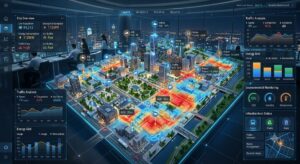
The City That Exists Twice
Digital twins and city management go hand-in-hand in the most progressive urban administrations on earth, and the ramifications of this union go well beyond the technical divisions that embraced the technology to begin with.
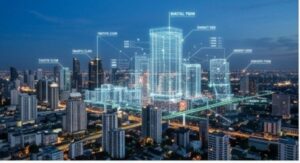
The digital twin is not a model. It is not a representation or a simulation in any traditional sense of the word. It is an ever-evolving digital duplicate of a physical object—a structure, an area, even a city—that takes information from the physical form and returns it as meaningful information. The city, in effect, now has two forms: one that can be seen physically and one that can only be seen virtually.
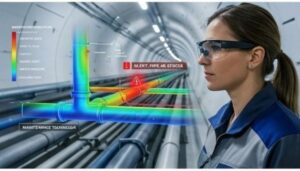
It is necessary to clearly distinguish between a digital twin and a traditional building information model, as these concepts are often conflated. A BIM model is a three-dimensional model of a building designed at a particular moment in time; it is an intricate drawing of such a building. A digital twin, on the other hand, is a dynamic tool that is linked to the building itself via a system of sensors and data feeds. The digital twin knows how the building behaves in real time and uses this information to predict its future behaviour.
What It Changes in Design
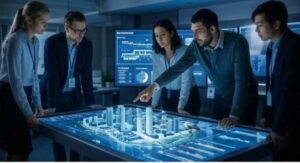
The implications of this technology for architecture start even before construction takes place. The development of a project design in the form of a digital twin provides the architect with the power to not only assess how the building will look or structurally perform in idealized conditions but also how it is really going to behave throughout the reality of its existence.
This means modelling how energy performance happens all year round, assessing how the structure will react in the event of extreme weather situations, simulating what happens when people have to evacuate a building in case of an emergency situation, and discovering when mechanical systems will most probably break down. It means that decisions that were made in the past based only on professional experience can now be validated before any foundation is poured into the ground.
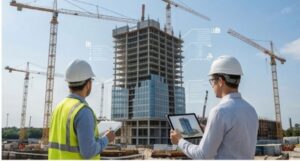
This fundamentally alters the dynamics of architectural risks. This also radically shifts the dynamics of architectural responsibilities. When a profession has the ability to predict failure using tools that can do that, its connection to the impacts of failures is fundamentally different from when it was actually trying to design in the dark.
While a digital twin cannot take away the uncertainty that comes from real-world situations, which are always going to be more complicated than any model, it brings the gulf between intent and actuality closer together.
What It Changes in City Management
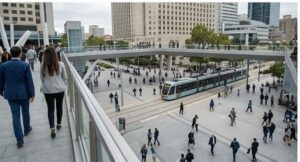
At the urban level, however, the ramifications are no less important and much more politically fraught. Singapore, Helsinki, and Amsterdam are all cities where a digital twin has been created of their urban landscapes, which enables planners to anticipate the impact of their decisions before making them—such as how a new tower will disrupt the wind patterns on the ground or how closing a certain road might affect traffic flows in an entire area. These are not just theoretical gains. They are practical applications of something that is being done now to shape our cities and our lives within them.
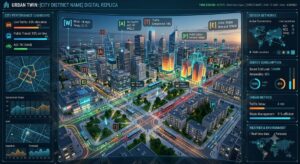
The information that goes into creating a digital twin of the city is huge, ever-flowing, and full of insight into the behaviour of urban populations. It is here where the power of the technology lies in tandem with the danger of the technology. A city that knows in real time how its streets are utilized, how its energy is being used up, and how well its infrastructure stands up to any stress is a city that will be able to solve any problems before they become too serious. It is also a city that has an immense amount of data on its citizens and their behaviours.
The Intelligence Behind the Mirror
Digital twins are not neutral tools. Every technology that consolidates information and computing capabilities in a single entity is always an expression of the agendas of those institutions that utilize them and the biases that exist in the data sets that feed into them.
The difference between a city that applies its digital twin towards optimizing the flow of traffic and energy efficiency versus a city that applies the technology towards monitoring social equity, housing, and environmental justice issues in its communities is profound.
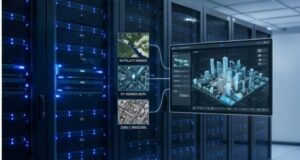
It should be obvious that digital twins are transforming the ways that our cities are designed and managed. Architecture, as a discipline that intersects with intelligence and the actualization of design, is uniquely positioned to influence this transformation profoundly.
The virtual representation of the city is already being built. It is only a matter of who will decide the purpose of it.