
Curated by ArchiRev Editorial | Feature Story | Published March 18th, 2026
Source: ZHA
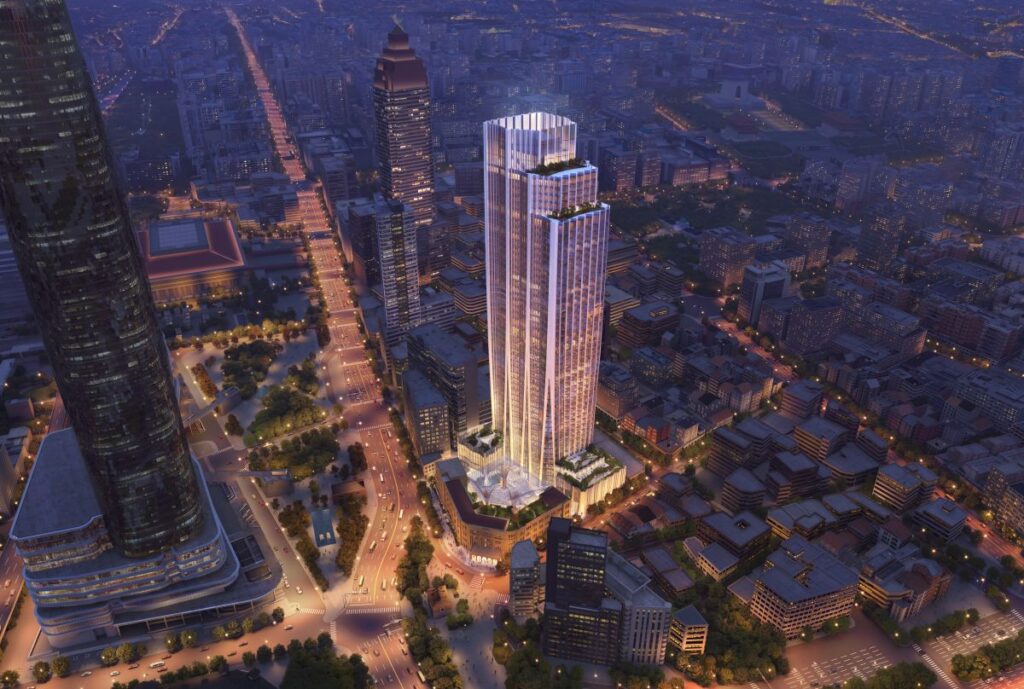
Aerial view of Beimen district showing project site context © Render by X Universe Visual Design
Following an international design competition, Zaha Hadid Architects (ZHA) have been selected to design the National Innovation, Creativity and Finance Centre (NICFC), in Taipei alongside C.Y. Lee & Partners. Located in Beimen district, known as the city’s financial centre, the project unites four establishments under the Financial Supervisory Commission (FSC) – stock exchange, futures exchange and depository and clearing corporation.
Situated at the crossroad of Zhongxiao West Road and Bo’ai Road, the site is located in one of Taiwan’s most bustling urban areas. As a point of intervention within a dense well of movement, history, and public life, its close proximity to major civic and cultural landmarks—including Taipei Main Station, Beimen Gate and Zhongshan Hall—both situates NICFC in this physical matrix while it also serves as an important new contributor to the network. They respond to this complexity by prioritizing walkable, accessible environments as they support the Western Gateway Project’s larger vision of enhancing Taipei’s public realm.
This interconnected pedestrian network of shopping avenues, plazas and courtyards are scattered throughout the site to reconnect surrounding civic nodes while maintaining Beimen’s existing urban views. This method allows the district’s historical layers to remain legible, even as new architectural interventions are added.
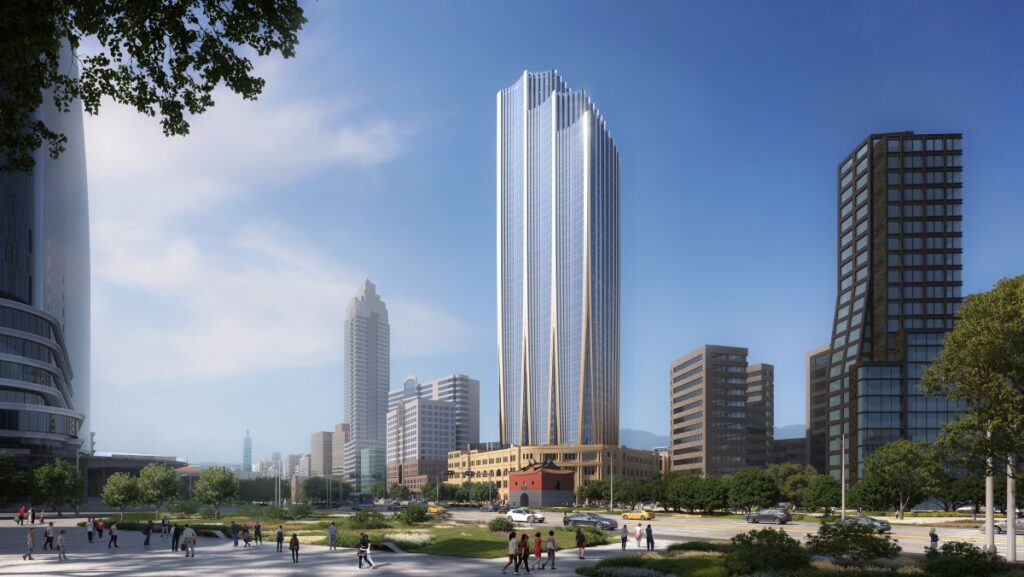
Diagram of pedestrian connectivity and public realm integration © Render by X Universe Visual Design
An integral part of this project is the integration and adaptive reuse of the existing Taipei Beimen Post Office located next to the development. The existing post office was originally opened in 1930 but was built 95 years ago. It is slated to be retained and restored with its later additions, which are considered obsolete, being removed. The original interior spaces are also slated to be repurposed as a museum of postal communications, with the existing portico area being converted into a community area.
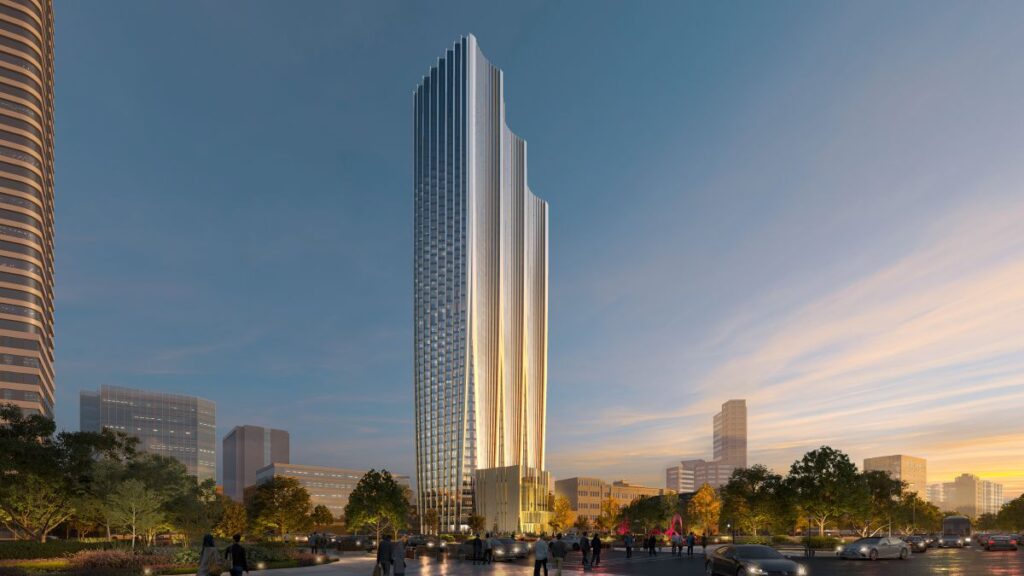
Restored post office building with integrated public courtyard © Render by X Universe Visual Design
In regards to the architectural form of the NICFC, it will be a five-story podium and a 47-story tower. The podium will be designed to be similar in scale to the adjacent heritage building. The podium will have elements such as pleated columns and a sculpted glazed canopy over the public events space in the courtyard. This transitional space will provide a connection from the old to the new, bringing a sense of continuity through different architectural periods. The tower will be derived from the fluted form of the local Phalaenopsis Orchid. The form of the tower will evolve as it grows out of the ground.
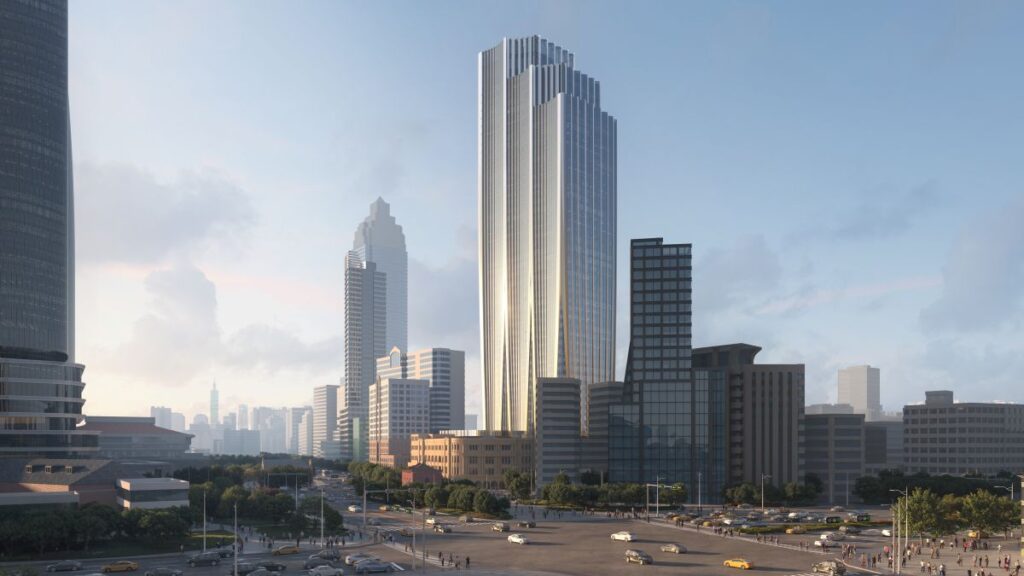
Tower form study inspired by orchid geometry © Render by X Universe Visual Design
On the other hand, efficiency and flexibility are maximized internally by achieving floor area usage rates of over 70%. Specific vertical zones are allocated for each of the four financial institutions. This provides maximum independent operation while sharing facilities such as flexible office space and a conference center. Access and movement are also considered by providing three independent elevator banks. These are for institutional, commercial, and service access, providing maximum efficiency.
The façade system of the building also plays a significant part. The responsive pleated façade system, along with a double-glazed unitized curtain wall system, provides control of solar and wind flow. The depth and angle of the façade are varied to ensure maximum efficiency. It is able to respond effectively to environmental conditions by providing maximum reduction of heat gain and natural ventilation. It has been designed to respond to the humid subtropical climate of Taipei by providing a “breathing” façade.
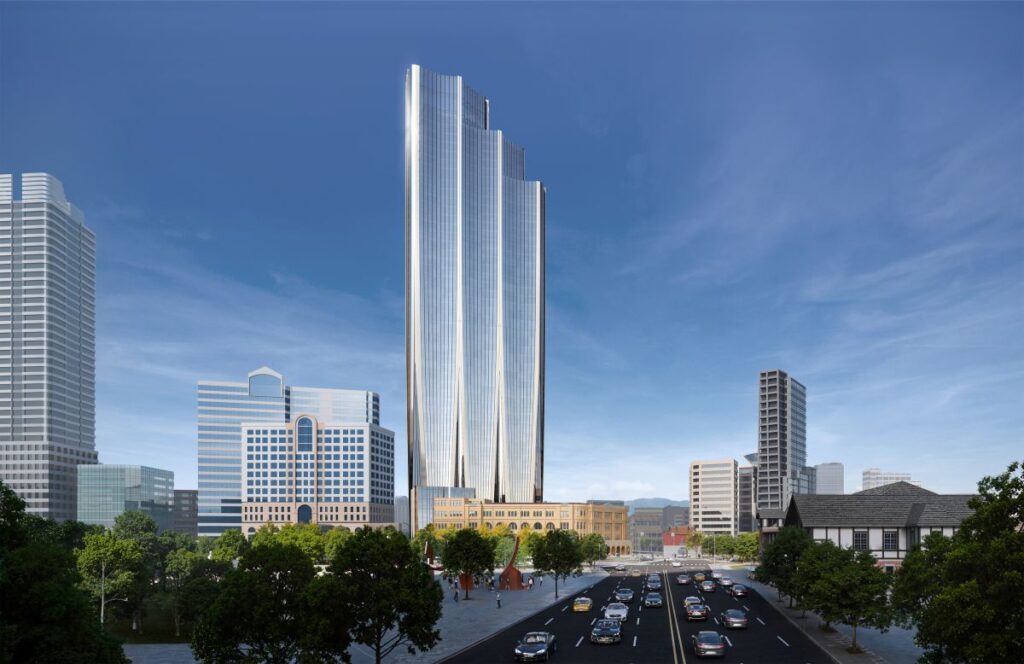
Façade detail showing pleated system and environmental response © Render by X Universe Visual Design
The way a building is oriented and the views it offers are important when designing it. The northern side of the building has concave bays that give you a view of the Qixing and Guanyin mountains. The eastern side is lined up with the axis of the city so you can see Taipei 101 and the Xinyi district. The western side has a façade that interacts with the Tamsui River. The southern side is designed according to the rules of the district. The building is stepped back in layers to reduce the force of the wind and provide shade on the upper floors.
Sustainability is a part of designing the NICFC at all levels. The building is going to try to get Platinum LEED and EEWH Diamond certification, which means it will not produce any carbon. The NICFC building will have photovoltaic cells on the façade and the rooftop to make energy. When choosing materials, for the NICFC building the designers will pick ones that can be recycled and do not produce VOCs. They will also use construction to reduce the carbon footprint of the NICFC building and make it last longer. The NICFC building will also be designed to use water by collecting and reusing rainwater.
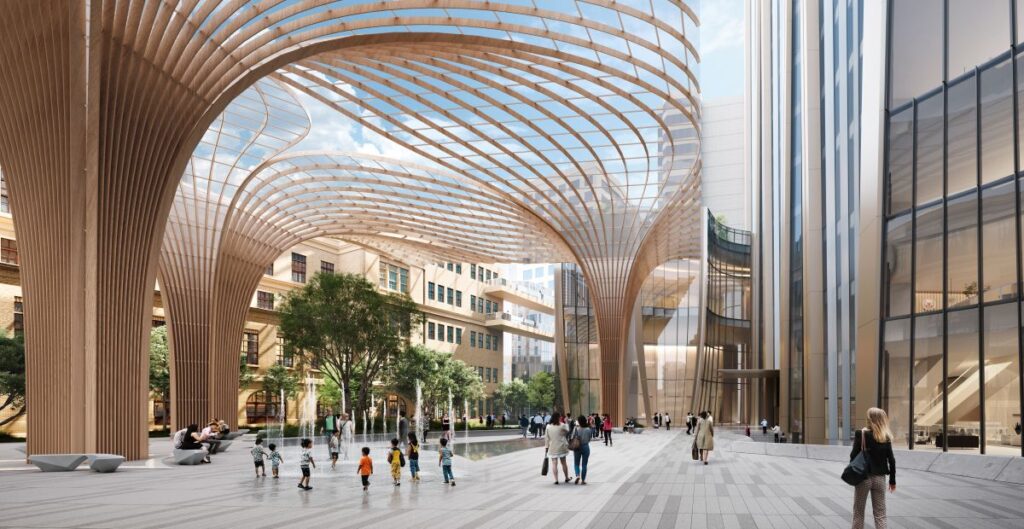
Façade detail showing pleated system and environmental response © Render by X Universe Visual Design
The people at NICFC are doing something cool in Taipei. They are taking things and making sure they are preserved. At the time they are making the city a nicer place to be in. They are also building things that are good for the environment. This way NICFC is making something that’s important for the city. It is a mix of new Taipei and it is a big part of the citys future. The city is going to be a place to live and work, with old things and new things together. NICFC is making this happen by combining heritage preservation and public realm improvement and high-performance architecture.
Project Team
Architect: Zaha Hadid Architects (ZHA)
ZHA Principal: Patrik Schumacher
ZHA Competition Project Directors: Paulo Flores (Design), Shao-wei Huang (Overall)
ZHA Competition Commercial Director: Charles Walker
ZHA Competition Project Architects: Mei-Ling Lin, Sebastian Andia
ZHA Competition Project Design Lead: Harry Spraiter
ZHA Competition Team: Abhilash Menon, Aditya Ambare, Aleksander Mastalski, Alex Nap, Arjun Kaicker, Bahaa Alnassrallah, Barbara Schickermueller, Berkin Islam, Bogdan Zaha, Carlos Bausa Martinez, Chales Walker, Christoph Geiger, Daniel Hamdan, Disha Shetty, Harry Spraiter, Henry Louth, Huiyuan Li, Jing Xu, Karina Linnsen, Lorena Espaillat Bencosme, Martin Gsandtner, Mei-Ling Lin, Ningxin Zheng, Patrik Schumacher, Paulo Flores, Sebastian Andia, Shao-wei Huang, Shajay Bhooshan, Shardul Awasthi, Shibani Choudhury, Teodor Andonov, Tommaso Casucci, Uli Blum, Vishu Bhooshan, Yusuf Rafi
ZHA Environmental & Sustainability Team: Abhilash Menon, Aleksander Mastalski, Bahaa Alnassrallah, Carlos Bausa Martinez (Team Lead), Disha Shetty, Jing Xu, Shibani Choudhury
ZHA CODE: Henry Louth, Shajay Bhooshan (Team Lead), Teodor Andonov, Tommaso Casucci, Vishu Bhooshan
ZHA+I: Arjun Kaicker (Team Lead), Christoph Geiger, Daniel Hamdan, Lorena Espaillat Bencosme, Uli Blum (Team Lead), Yusuf Rafi
Consultants
Executive Architect (JV): C.Y.Lee & Partners
Associate Architect (JV): Oneness & Associates Architects Planners
General Engineering Consultants (JV): CECI Engineering Consultants, Inc.
Structural Design and Seismic Supervision: Evergreen Consulting Engineering, Inc.
Structure Concept: Cundal Hong Kong Limited Sustainability Consultants: Arup Group Ltd.
Geotechnical Consultant: Sino Geotechnology INC
MEP: Cheng-Yi United Engineering Consultants Co., Ltd.
Environmental Consultant: Segreene Sustainable Design & Consulting, Inc.
Façade Design Consultant: VS-A Facade Engineering
Traffic consultant: EasyGoGo Technology Inc
Landscape Consultant: Environmental Arts Design
Associates Property Management Consultant: Professor Kung-Jen Tu
Interior Design: Olin International Design Co. Ltd. Lighting
Design consultant: Unolai design
International Workplace Consultant: Cushman & Wakefield
Historic Restoration Consultant: Pu-Ming Tseng Architect & Associates