Typologies: Cultural, Education, Transformation, Public
Themes: Architecture, Adaptive Reuse, Education, Urban Regeneration, Culture
Status: Realised
Location: Tirana, Albania
Year: 2018–2023
Surface: 11,835 m²
Client: Albanian-American Development Foundation (AADF)
Awards: Mies van der Rohe Award 2024 — Nominee
Photographer: Ossip van Duivenbode, Filip Dujardin
The Pyramid of Tirana by MVRDV is considered to be one of the most daring initiatives in terms of adaptive reuse realized in Eastern Europe recently. Initially, the building was constructed as a tribute to the memory of the founder of communism in Albania, Enver Hoxha. Today, however, the building has undergone an incredible transformation and has become a contemporary centre of youth, technologies, education, and culture. The building was finished in 2023.
Aerial view of the restored Pyramid of Tirana showing the stepped concrete structure and new public landscape © MVRDV
The Pyramid, built in 1988, was intended initially to serve as a museum devoted to the life of Hoxha. After the fall of Communism, the building had a very uncertain fate—it changed its function several times, being a place of congress, broadcasting station, disco club, event venue, and even a temporary camp for soldiers. However, gradually falling into disrepair, the abandoned building became not only a city symbol but also an unofficial playground for numerous inhabitants of Tirana who used to climb on its concrete slopes.
Instead of destroying such a controversial object, MVRDV decided to preserve it together with all its history and symbolic meaning. As the building was not only a symbol of a dictatorship but also of significant cultural importance for local people, it was a question of transforming an oppressive symbol into an embodiment of openness, study, and opportunity.
Historic and contemporary comparison showing the Pyramid before and after renovation © MVRDV
On one hand, this intervention conserves the original form of the building by drastically changing its use and perception of space. Significant parts of the existing concrete construction have been restored, ensuring that the distinct geometric shape of the pyramid remains easily identifiable in the skyline of Tirana. New openings have been added, introducing the much-needed natural light deep into the interior and establishing more vivid links between the inside and outside spaces.
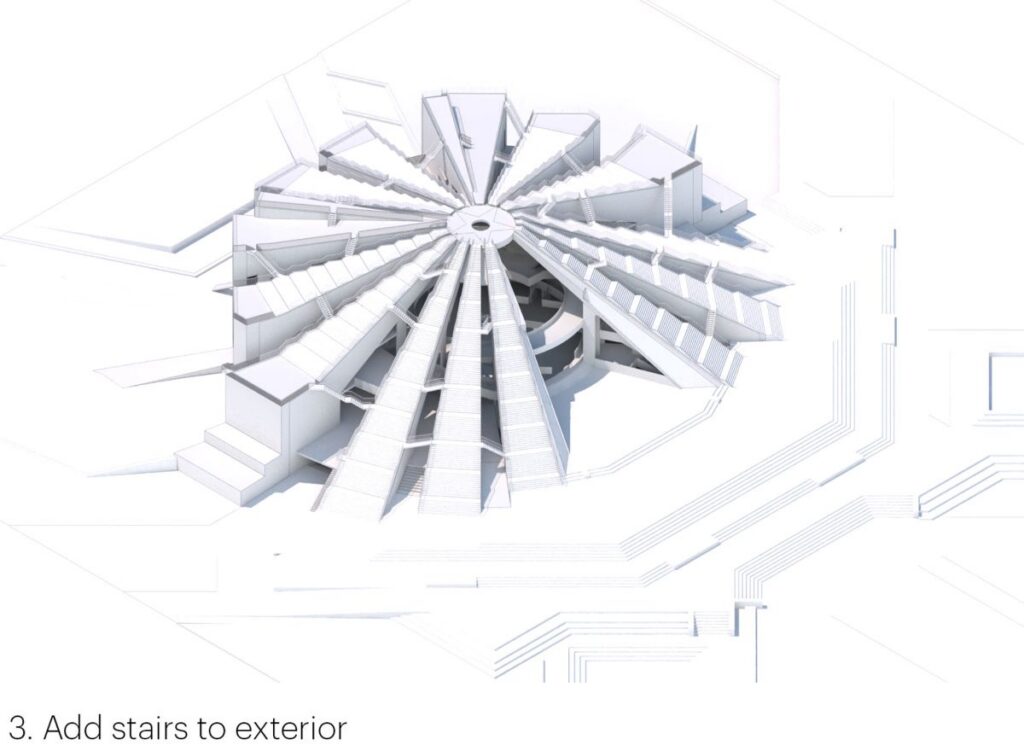
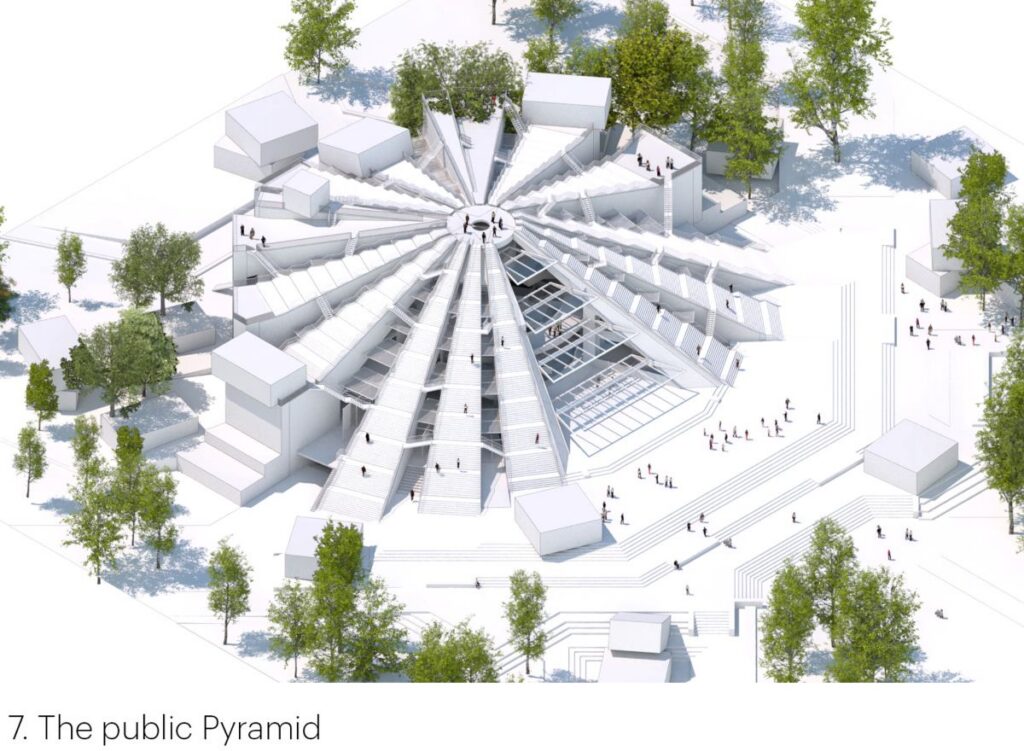
Another prominent feature of this architectural intervention is turning the inclined surfaces of the building’s roof into public circulation spaces. The installation of new staircases on the exterior ensures that visitors can reach the top of the Pyramid safely and enjoy magnificent views of Albania’s capital. An activity that was once forbidden becomes an inherent element of architecture here.
Exterior staircase integrated into the Pyramid’s sloping roof leading to the summit viewpoint © MVRDV
TUMO Tirana, a free education program centered around technology, digital media, computer coding, animation, robotics, film making, and design, stands at the center of this project. The Pyramid Building currently offers a space for hundreds of young Albanian people who will have the opportunity to acquire skills required by their country for its further development. Through its educational function, the building obtains an entirely new significance, moving away from the discourse related to power and authority.
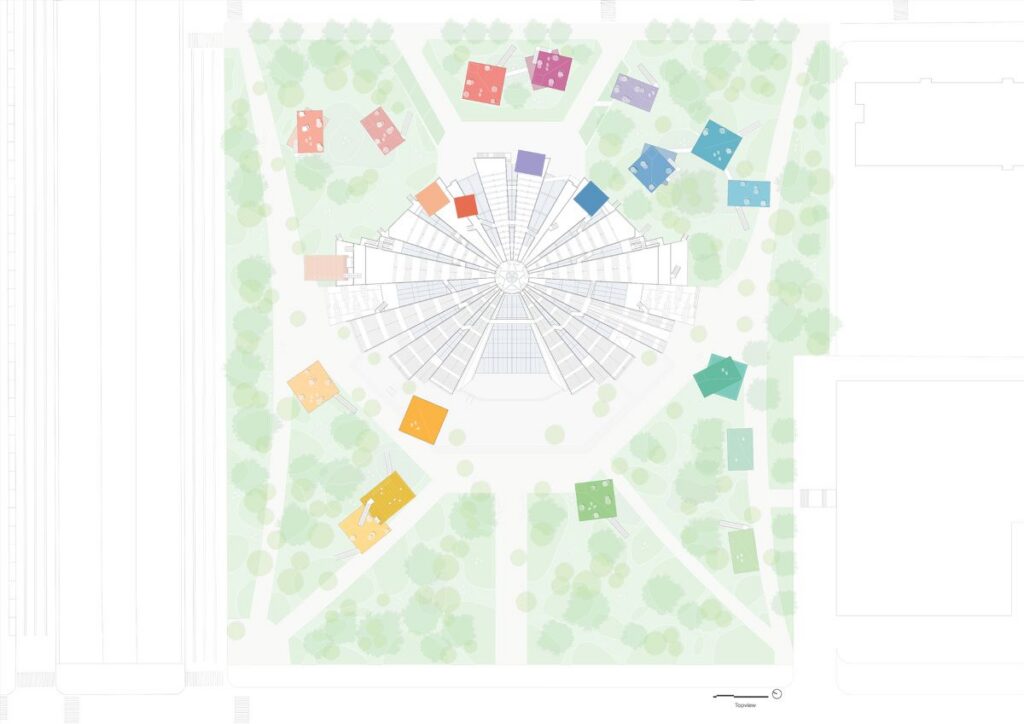
The interior spaces were arranged as a learning facility comprised of colorful structures, which have been inserted into the existing concrete shell of the building. The structure of these inserted volumes provides different rooms: studios, cafes, classes, etc. It can be said that, through the new program, the architects have managed to keep the spirit of the old building.
Interior view showing colourful educational pavilions beneath the restored concrete shell © MVRDV
Colourful books create a dialogue between past and present through their striking colour, in contrast to the exposed concrete of the architecture. This way, visitors can easily differentiate between the past architecture and the new interventions, keeping the memory of the past intact and not covered by new designs.
However, the renovation does not stop with the building alone. The entire landscape around the Pyramid has been transformed into a public park where people can come to spend time. With pathways, seats, plant areas, and gathering places, the site can be considered an active civic space.
Public Plaza and landscape surrounding the Pyramid with visitors gathering around the building © MVRDV
It is also a great example of the importance of adaptive reuse from the perspective of the environment since through the reuse of the building, a considerable amount of carbon was saved in comparison with tearing down the building and constructing a new one from scratch.
Nowadays, the Pyramid is one of the most popular landmarks for the citizens of Tirana where people meet up, have fun, discuss important matters, etc. In other words, it can be said that from being just a memorial devoted to one specific politician, it transformed into a communal facility for a whole generation of Albanian people.
Evening view of the illuminated Pyramid with activity inside and people on the rooftop terraces © MVRDV
The Tirana Pyramid is an example of adaptive reuse that shows that preservation isn’t the only way through which new cultural significance can be created. By carefully balancing restoration and public participation, MVRDV has managed to transform one of Albania’s most divisive architectural works into something positive for the city.
Architect: MVRDV
Founding Partner in Charge: Winy Maas
Partner: Bertrand Schippan
Client: Albanian-American Development Foundation (AADF)
Programme: TUMO Tirana
Location: Tirana, Albania
Photographer: Ossip van Duivenbode, Filip Dujardin