

Curated by ArchiRev Editorial | Feature Story | Published June 15th, 2026 | Source: 3XN
Typologies: Sports Arena, Public, Leisure, Landscape Integration
Themes: Architecture, Sports, Public Space, Community, Landscape
Status: Realised
Location: Munich, Germany
Year: 2024
Surface: 62,500 m²
Client: Red Bull Stadion München GmbH
Photographers: Angelo Kaunat, Franco Casaccia, Rasmus Hjortshøj
SAP Garden Munich, designed by 3XN, marks the arrival of a new era at what is one of Germany’s most renowned cultural landscapes. Situated in the Olympic Park in Munich, which was formerly known as the Olympic Velodrome, the 62,500 m² venue hosts the city’s professional ice hockey team, EHC Red Bull Munich, as well as its elite basketball franchise, FC Bayern Basketball. Unlike other structures that have tried to rival the architecture that emerged from the 1972 Olympics, the new venture takes a different path by merging into the park’s landscape.

Aerial view of SAP Garden integrated within Munich Olympic Park landscape, showing green roof and surrounding parkland © 3XN
The design of a modern arena in the Olympic Park area, which is protected, was a daunting task for the designers. The environment and the buildings already constructed in the park by Frei Otto and Günter Behnisch had a particular architectural signature. Instead of erecting a dominating building, the designers chose to extend the terrain through the design of SAP Garden. This is achieved through burying three training ice hockey rinks under an artificial hill. The pedestrian movement remains uninterrupted throughout the site because of the design approach.


Exterior view showing the arena emerging from the landscaped hill and green roof system © 3XN
The primary structure stands out as an asymmetrical oval shape towering over this landscaped podium. This organic form is derived from the fluidity of its surroundings as opposed to the conventional geometry found in today’s sporting facilities. With a vegetative roof, this facility becomes an architectural component in keeping with the overall landscape of the city when viewed from higher elevations within the Olympic Park.
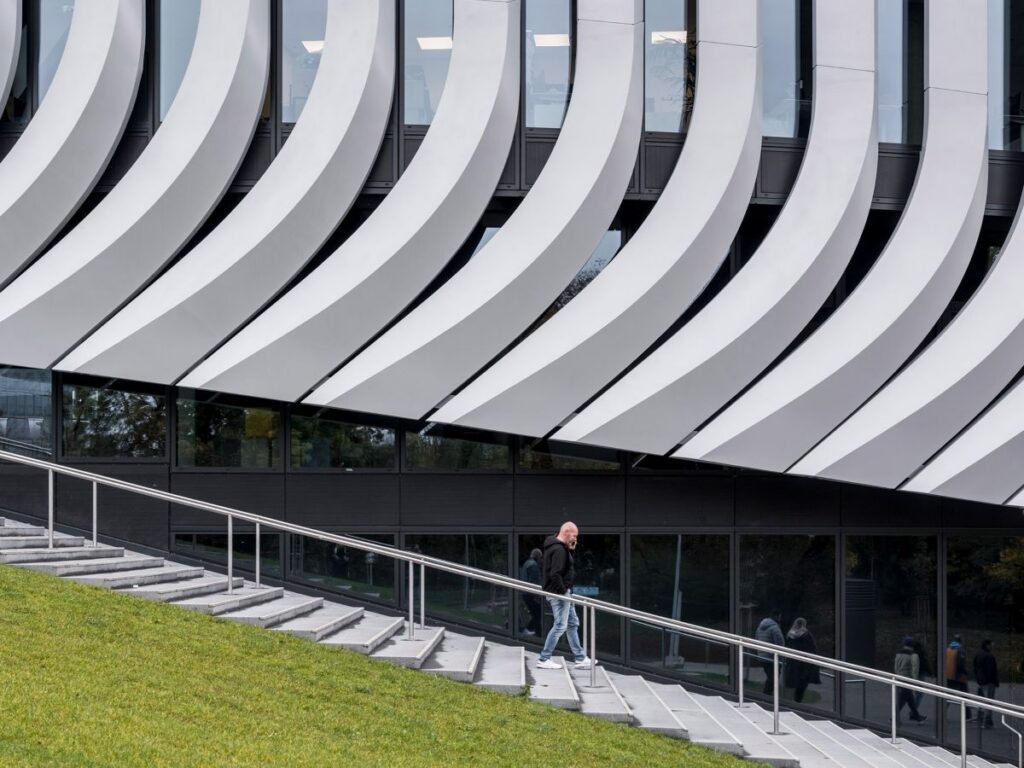
Exterior façade view highlighting the curved form and vertical aluminium pilasters © MVRDV
The most defining architectural characteristic of this building is the building façade. Over 260 individual aluminium pilaster panels, which each have a unique geometry, envelop the stadium, making an impressive statement above the glass entrance points of the building. Each aluminum piece on the building façade has a different geometric shape, allowing the façade to be unique depending on the angle from which it is viewed. This solution provides simplicity and complexity at the same time, giving a building the needed character but still retaining elegance due to the location.


Close-up of the vertical aluminium façade elements and glazed entrance sequence © 3XN
On the inside, SAP Garden has been made flexible and conducive to a certain atmosphere. It can accommodate up to 10,700 people for ice hockey and about 11,500 for basketball. Due to the fact that both of these sports have different dimensions in terms of space requirements, it became necessary to design a highly advanced seating system that would allow efficient transformation from one format to another depending on the circumstances.


Interior arena bowl configured for basketball, showing adaptable seating arrangement © 3XN
Besides the world of professional sport, this project is envisioned as a year-round place for the general public. In addition to the three other ice rinks, which lie beneath the surface, and contrary to popular belief, they are not only for use by professional athletes. Instead, schools, sport societies, and local people have access to such facilities all year round. This idea was rooted in the spirit of democracy with which Olympic Park was created.
The scope of this project goes way beyond its sporting arena. Retail units, restaurants, conference rooms, offices, entertainment venues, and gaming gardens make this space lively both during the day and at nighttime. A publicly accessible roof terrace completes the complex and serves as an additional attraction point to the existing city skyline and Olympic Park. Thus, this building is always bustling with visitors regardless of whether there are large events taking place or not.

Rooftop terrace overlooking Munich Olympic Park and surrounding cityscape © 3XN
Interior architecture, too, has been designed around the same philosophy. Flexible lighting and media designs as well as adaptable spaces ensure that different identities are created as per the requirements of the event. Whether staging a basketball game, a world hockey game, or a musical performance, this building is capable of creating different moods while still sticking to one architectural language.


Interior public concourse showing hospitality spaces, circulation, and event atmosphere © 3XN
With its opening scheduled for 2024, SAP Garden represents an example of how today’s sports architecture can relate to its past without imitating it. Instead of viewing Munich’s Olympiakultur as a hindrance, 3XN has built on this concept to create a space where the community, the landscape, and public life play just as important a part as sport itself. And what is more, SAP Garden has become yet another icon of Munich—strengthening the link between architecture and the landscape.


