
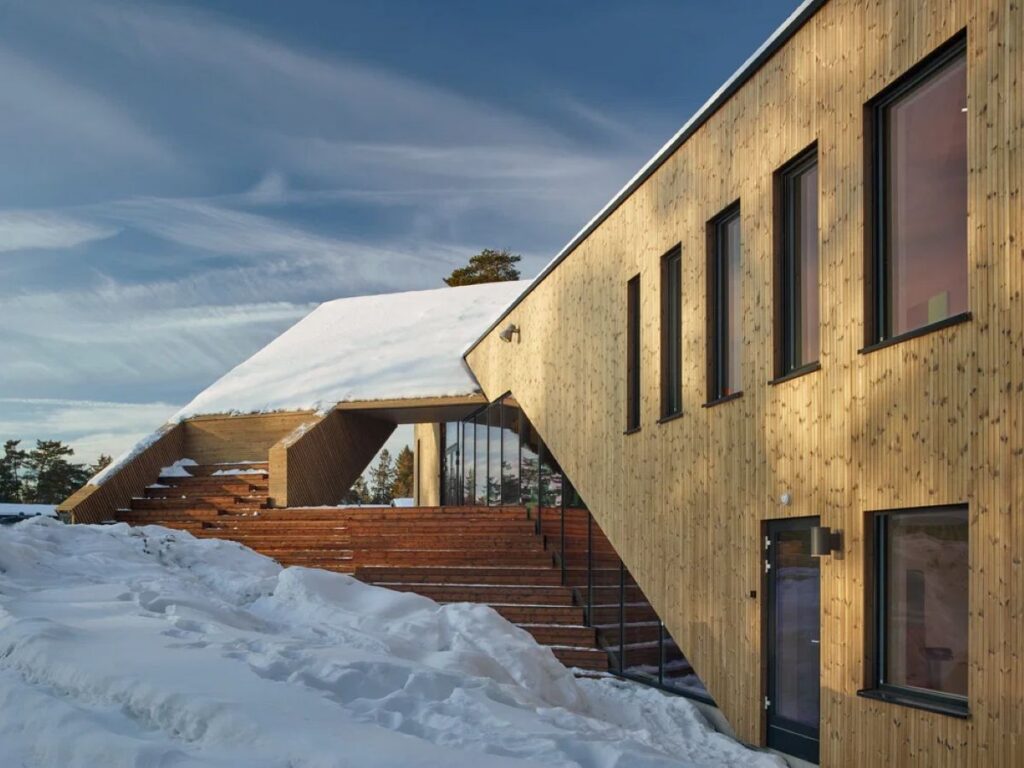
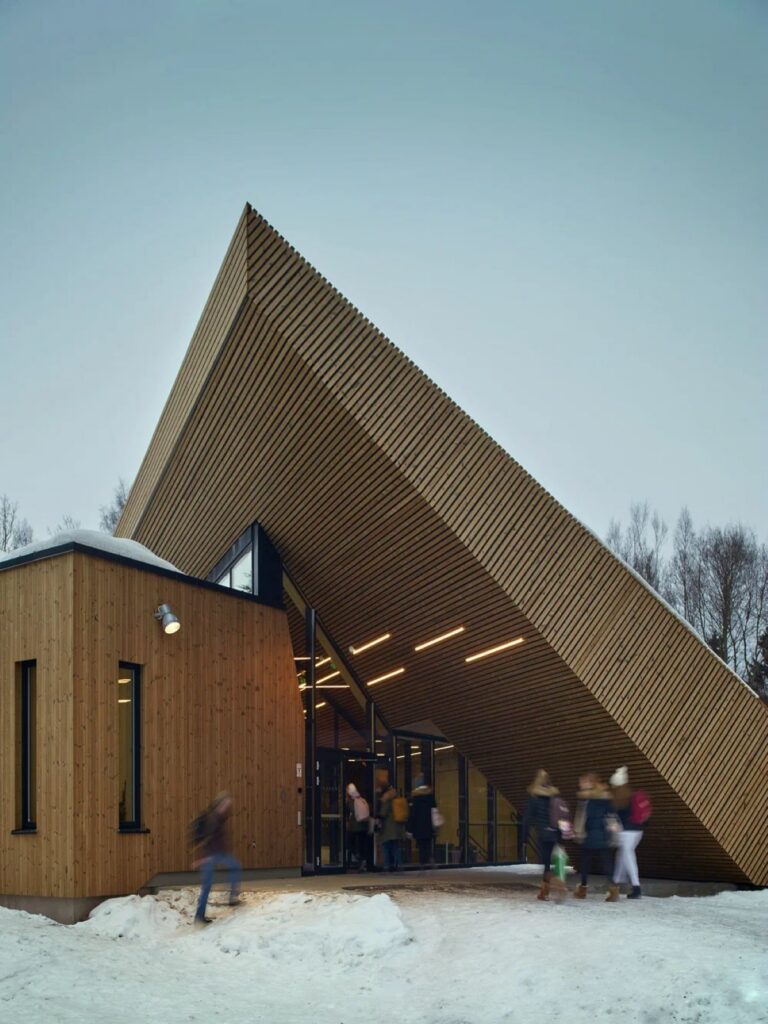
Exterior view of the completed Powerhouse Drøbak Montessori School showing the building massing, the south-facing solar plate, and its integration within the surrounding forest landscape © Snohetta
Curated by ArchiRev Editorial | Feature Story | Published May 25th, 2026 | Source: Snohetta
Typologies: Sustainability, Education & Research
Disciplines: Architecture, Landscape Architecture, Interior Architecture
Status: Completed
Location: Drøbak, Norway
Year: 2015–2018
Size: 960 m²
Client: Drøbak Montessori School
Collaborator: Powerhouse, Skanska Norge AS, Erichsen & Horgen, Fr. techn. Kristoffer Apeland AS, Brekke og Strand akustikk AS, Multiconsult AS, Heiberg og Tveter AS
Powerhouse Drøbak Montessori School is the world’s first energy-positive educational building — a 960-square-metre secondary school completed in 2018 by Snøhetta on a forested site in Drøbak, Norway.
Commissioned in 2015 by Drøbak Montessori School, the project extends the Powerhouse concept — previously applied to office buildings — into an entirely new building typology, demonstrating that a school can be designed to produce more energy than it consumes while simultaneously functioning as a rich social and educational environment for its students.
Detail view of the building envelope showing the insulation strategy, the fenestration pattern, and the material treatment of the exterior wall construction © Snohetta
This project stems from the overlap of three factors: the principle of energy efficiency, the characteristics of the forested site, and the educational methods of Montessori.
The three lines are never viewed as independent limits to be weighed against each other. Instead, they are combined right away into a united architectural statement, interacting and supporting each other on all levels. This results in a building where engineering solutions and educational considerations cannot be distinguished; they merge in the construction decisions that provide positive energy output of the school.
In order for this to be done, a multidisciplinary team had to be brought on board from day one of the project. The teachers, students, and school administration, along with the entire community of engineers and specialists who were supposed to optimize the building’s environmental performance, were all part of this design process. This approach ensured that the solution not only addressed the high standards set by the Powerhouse but also considered how the Montessori method really functions, namely by encouraging student autonomy and movement.
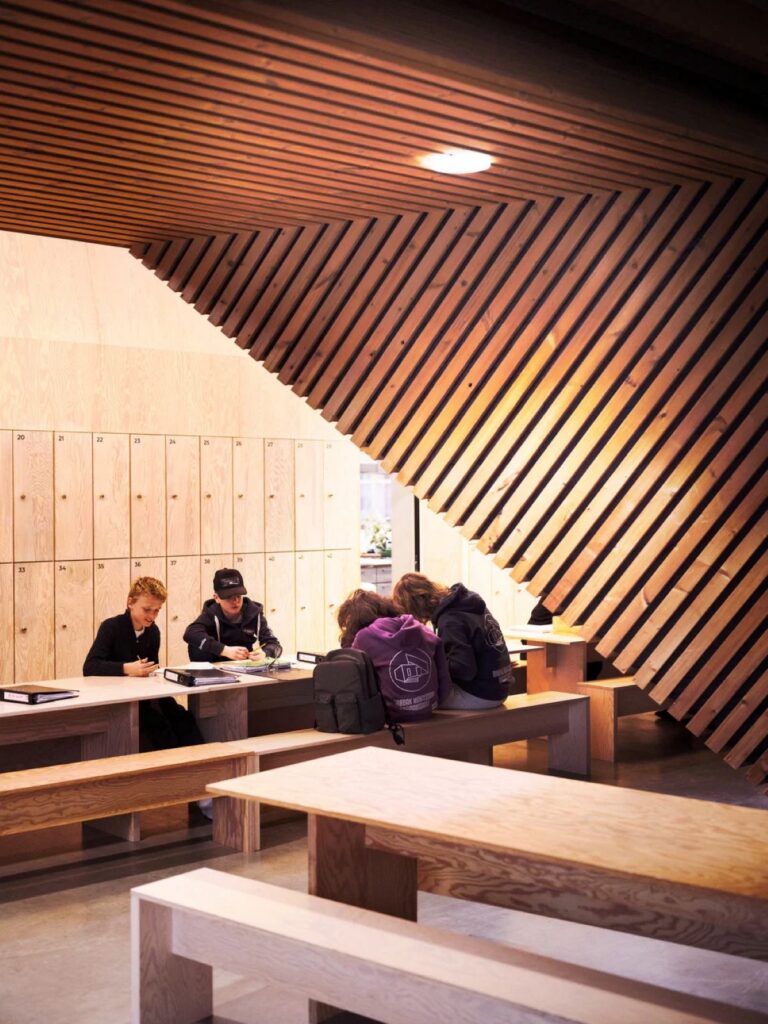
Interior view of the indoor amphitheatre space formed by the solar plate, showing the spatial quality of the learning environment, the timber materiality, and the sectional relationship between the plate and the occupied floor below © Snohetta
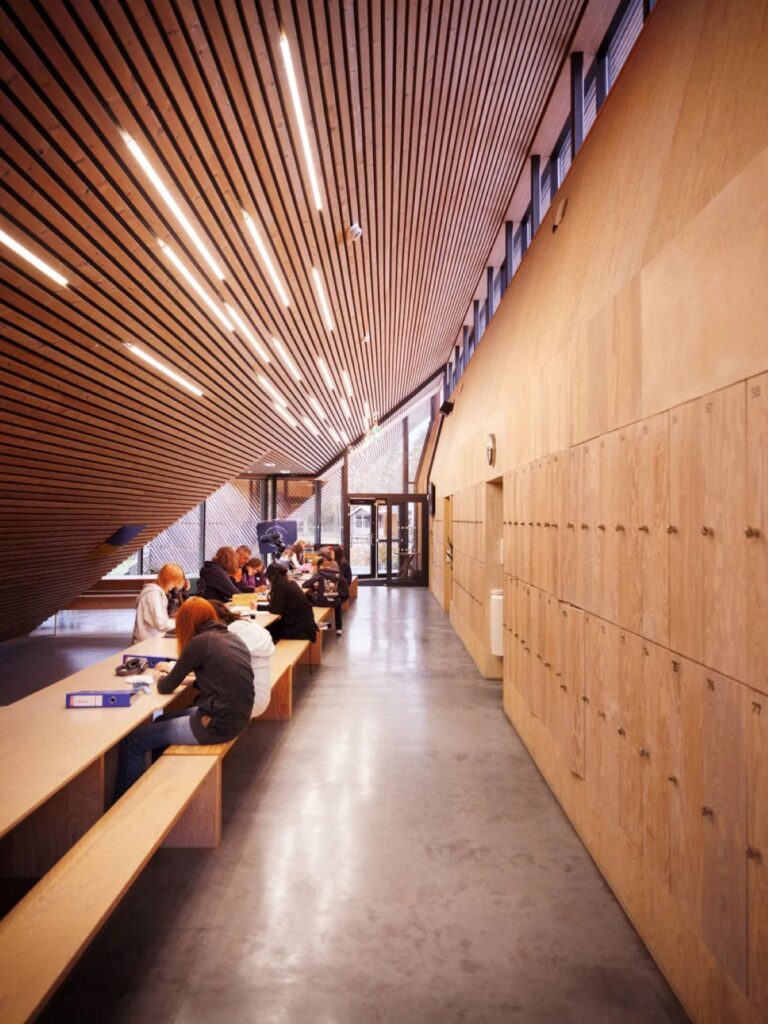
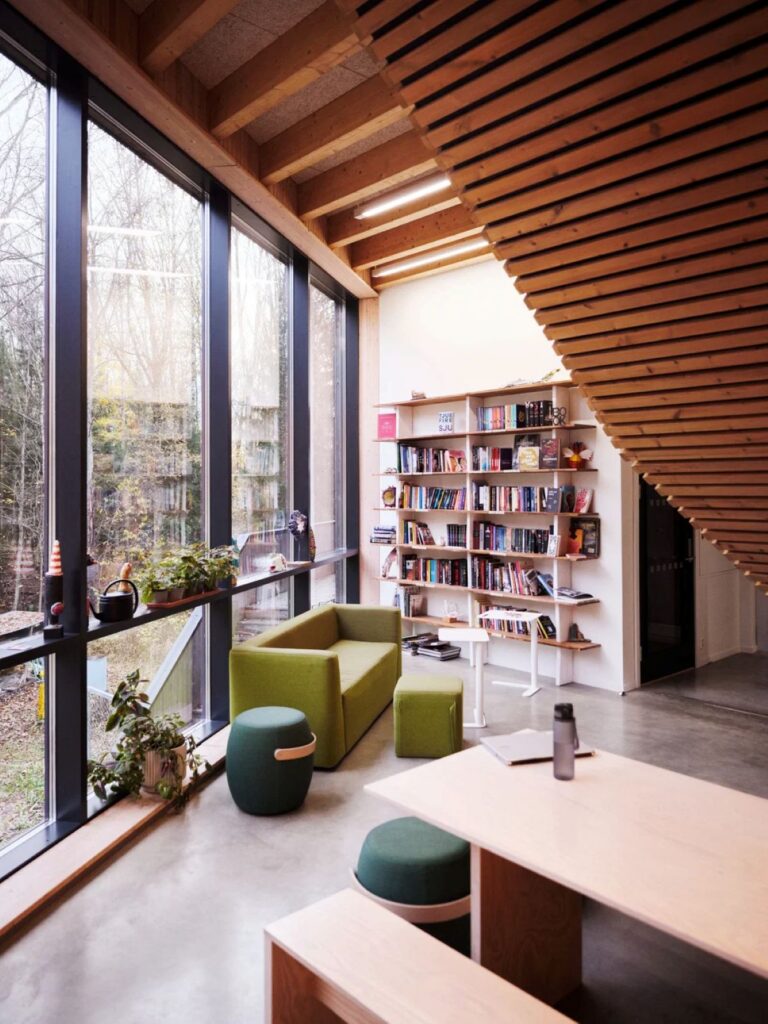
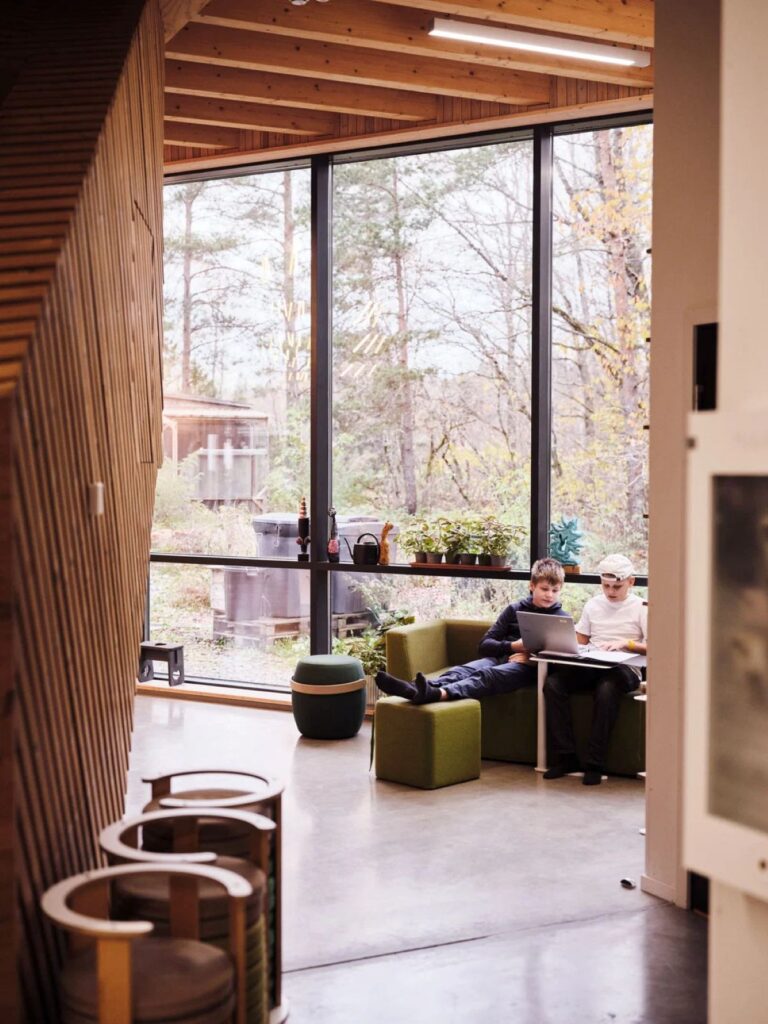
Interior classroom or communal learning space showing the daylighting quality, material palette, and the spatial organisation informed by the Montessori educational method © Snohetta
The most distinguishing feature of this structure would be the solar plate. This is basically a tilted plane within the building that is used to define the solar energy system and the spatial configuration of the building simultaneously. Placed to face the South at an angle of 33 degrees to improve the performance of the solar cells throughout the year, the solar plate is designed to bring about natural ventilation by taking in fresh air through the bottom and pushing the exhaust air through the top.
The photovoltaic panels responsible for producing power for the entire building lie on the top of the solar plate. Spaces defined by the solar plate include an outdoor amphitheatre on one side, an indoor amphitheatre and stairway on the other, thus creating a distinctively spatial character to this Montessori school.
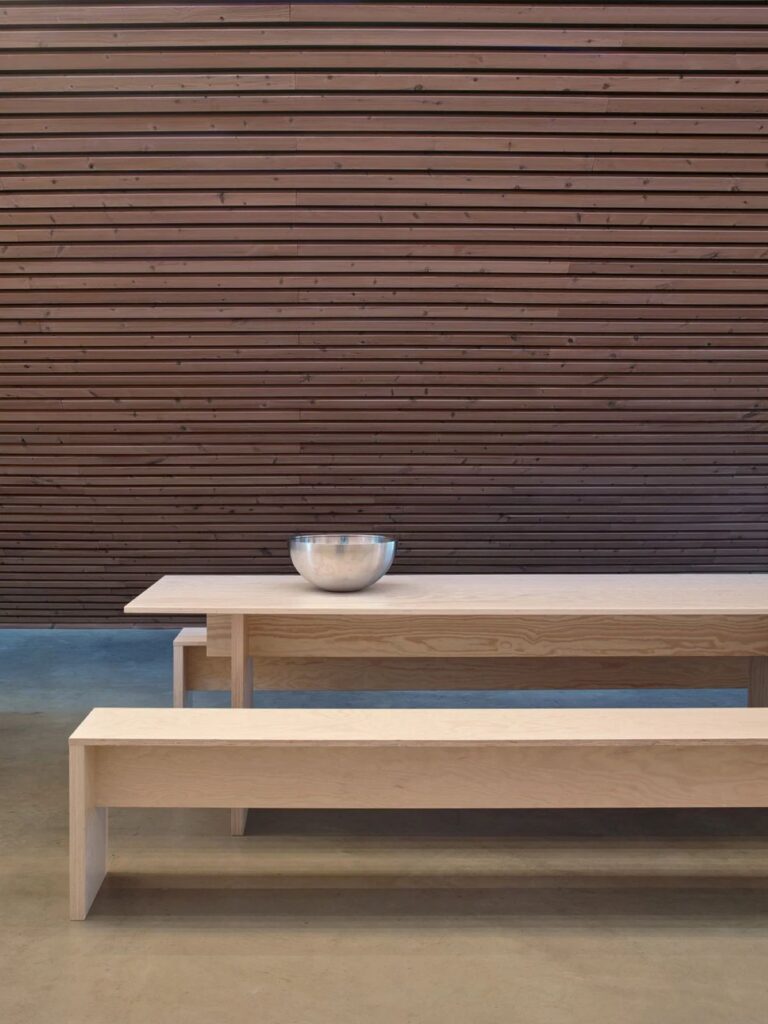
Detail view of the building envelope showing the insulation strategy, the fenestration pattern, and the material treatment of the exterior wall construction © Snohetta
The school itself covers around 900 square meters of heated area that is predominantly arranged in one level, while the second level is made possible by using the gradient of the land upon which the structure is built. Even with its small dimensions, the overall approach towards the use of energy in the building is detailed and focused.
The total energy consumption of the structure amounts to less than a fourth of what can be expected from a structure with equal dimensions to that of a school. Heating and ventilating the premises were approached based on the previous experience with Powerhouse Kjørbo.
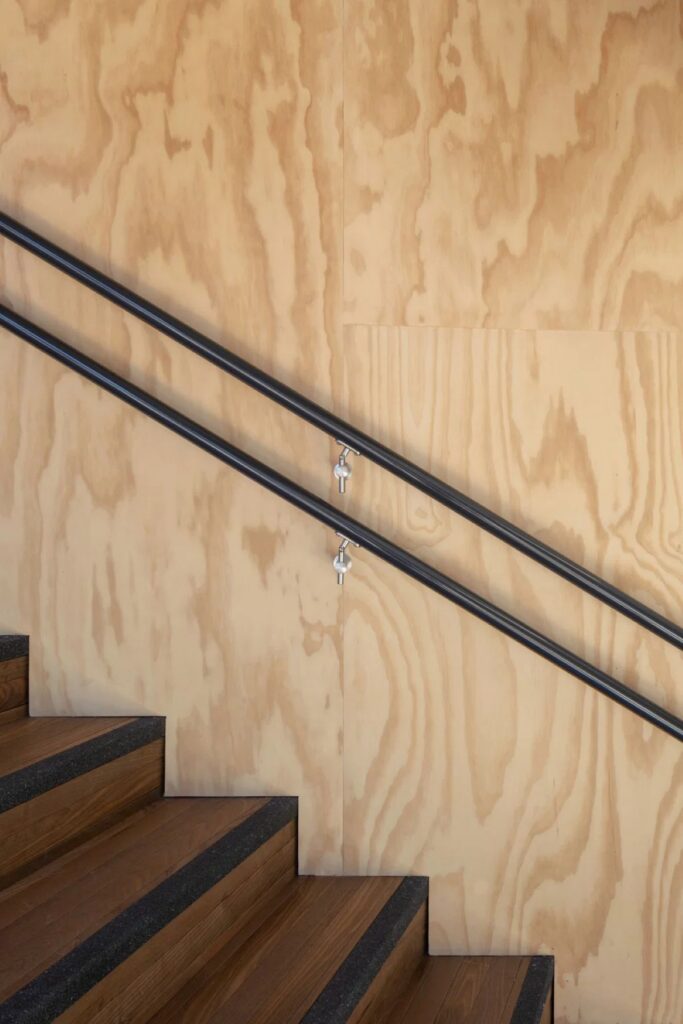
Detail view of the building envelope showing the insulation strategy, the fenestration pattern, and the material treatment of the exterior wall construction © Snohetta
Throughout the entire year, the building generates 30,500 kWh worth of energy through the production of solar power, a quantity that not only meets but even exceeds its yearly energy demand and certifies the building as being the world’s first school to satisfy the requirements of a powerhouse.
The building sits in the midst of the forest surroundings of Drøbak, and the association between the building and the landscape around it, apparent both through strategically positioned openings and from the building’s exterior common areas, strengthens this connection to nature, which is an essential component of the Montessori approach.
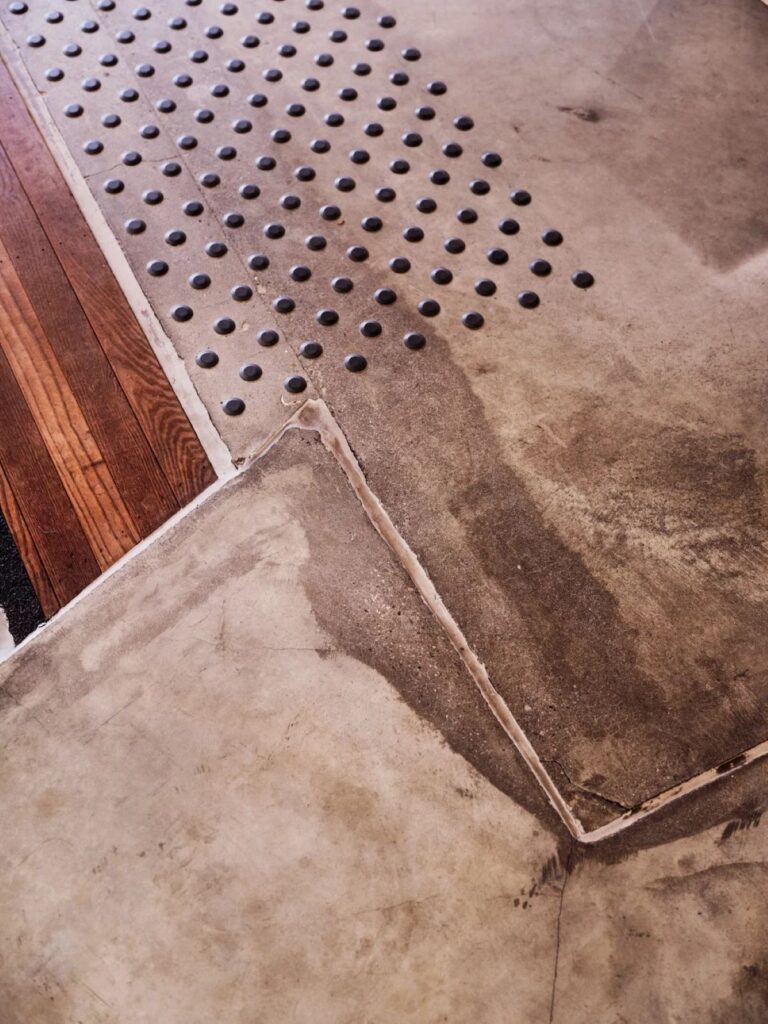
Detail view of the building envelope showing the insulation strategy, the fenestration pattern, and the material treatment of the exterior wall construction © Snohetta
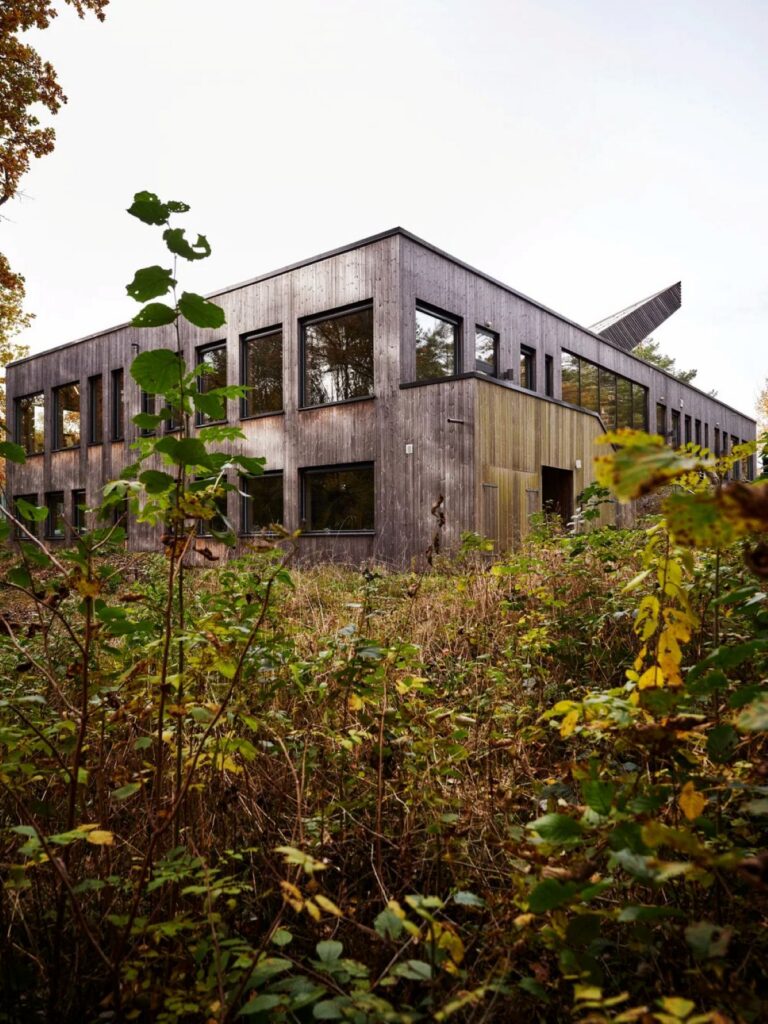
Exterior view showing the building in its forest setting from a distance, demonstrating the scale relationship between the compact built form and the surrounding natural landscape, and the modest material presence of the building within it © Snohetta
Architect: Snøhetta
Collaborators: Powerhouse Partnership
Contractor: Skanska Norge AS
MEP Engineering: Erichsen & Horgen
Structural Engineering: Fr. Fr.techn. Kristoffer Apeland AS
Acoustic Engineering: Brekke og Strand akustikk AS
Multidisciplinary Engineering: Multiconsult AS
Landscape: Heiberg og Tveter AS
Photography: © Robin Hayes, © Stephen Citrone