
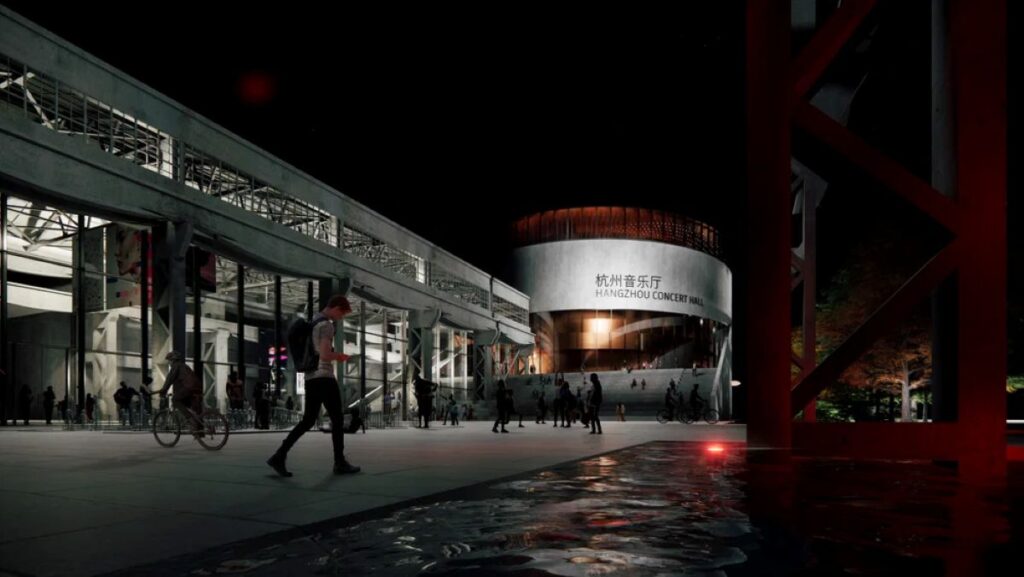
Exterior view of retained factory with inserted cylindrical volume © Snøhetta
Curated by ArchiRev Editorial | Feature Story | Published April 24th, 2026 | Source: Snøhetta
Typologies: Performance Space, Transformation & Expansion, Public Space
Status: Design Proposal
Location: Hangzhou
Client: Hangzhou Philharmonic Orchestra and Hangzhou Government
Collaborators: BIAD – Beijing Institute of Architectural Design
Size: 65,143 m2
Scope: Architecture, Interior Architecture
Hangzhou’s industrial legacy gave rise to the Hangzhou Concert Hall, and the Hangzhou Boiler Factory was converted from a boiler manufacturing facility into a cultural hub. Constructed in the 1950s, the Hangzhou Boiler Factory played a crucial role in the industrial development of Hangzhou until its closure and relocation in 2013. In addition to serving as the future home of the Hangzhou Philharmonic Orchestra, the proposal calls for the construction of a new cultural complex that will house an office building and a 1,600-seat music hall. It also aims to revitalize the surrounding region.
The former steam drum container workshop is the focal point of the intervention. This significant building, which possessed one of the biggest single-span areas in Asia, symbolized the industrial potential of the Chengbei region. In order to incorporate a new cylinder form into the existing building, parts of the original factory’s five-section roof and facade are removed. The performance hall’s new layout, which is modelled after a vineyard, pays homage to the steam drums that were originally made there. The music hall’s new shape is distinct from the factory’s existing structure, exhibiting a clear division between the old and the new.
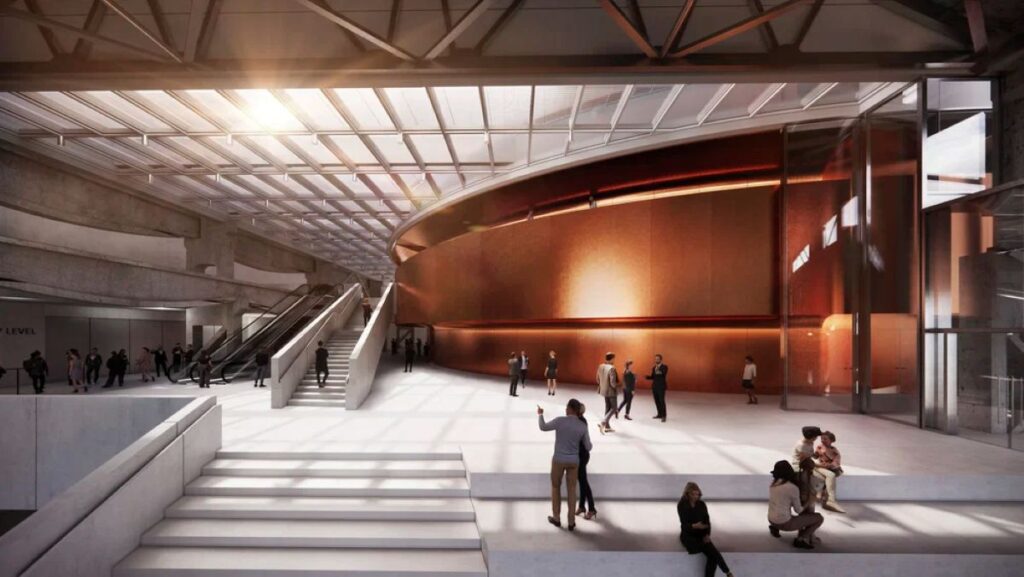
Interior of large industrial hall with new concert hall structure © Snøhetta
The building’s architecture aims to strike a balance between the conflicting forces of likeness and diversity. Compared to the current factory, the newly built volume is lighter and more contemporary. Furthermore, the new structure’s curve lessens its visual impact in relation to the previous footprint. Natural light can enter the building through a clear glass curtain wall at the base of the new extension, which provides the controlled environment required for usage in performing arts venues and creates a soft transition between the outside and within.
A second volume that will expand the site and include office and rehearsal facilities is being created next to this project. With softer edges and a curved sun shading system, the second volume’s new envelope offers visual relief from the factory’s harsh industrial forms while preserving the impression of cohesion throughout the entire site.
A key component of the overall design idea is the initial objective of maintaining the existing structure. The current factory will mostly remain in its current condition, with the exception of the removal of some exterior wall and roof elements. In order to comply with current local and state seismic construction requirements and guarantee that the building maintains its original industrial character while remaining as structurally sound as feasible, additional structural reinforcement will be applied where necessary.
The freshly built addition’s ground floor will once again be a major interior public area. This additional 3,000 square meter indoor space, which is enclosed by the current roof, will serve as a sizable “living room,” accommodating activities such as concerts and community gatherings. The high level of visual openness and continuity between the newly built expansions and the original manufacture will improve the factory’s functional quality while introducing numerous additional community-use features.
Where appropriate, additional controlled environments will be interventions. Compared to the exposed concrete utilized throughout the current building, the 650-seat music hall’s wood wall cover and floor finish will create a cozier, friendlier atmosphere for audiences and artists (but is required to comply with acoustic performance criteria).
A new, important portion of the historic industrial site is redefined as both a location of memory and a physical structure (factory/museum) by carefully striking a balance between insertion and preservation. A portion of the overall story will continue into this new (cultural) program of development, preserving the industrial memory and giving the site the chance to grow and change without losing its identity.