

Photo Credit Zaha Hadid Architects | The photographers Hufton + Crow own the copyright to this photograph
The Heydar Aliyev Center stands as a tectonic shift in Azerbaijan’s architectural narrative — a post-Soviet emblem that transcends traditional monumentality to embrace fluidity, openness, and cultural reinvention. Commissioned by the Republic of Azerbaijan following an international competition in 2007, this 101,801 m² mixed-use cultural complex redefines the role of architecture as both urban infrastructure and symbolic landscape.
Located on a 111,292 m² site in Baku, the Center is conceived as a continuous surface — a topographical wave that rises from the plaza and envelops program, people, and landscape into a seamless architectural experience. The design rejects orthogonal rigidity in favor of non-linear geometries, drawing inspiration from Islamic architectural traditions of ornamental continuity, calligraphic flow, and non-hierarchical space.

Photo Credit Zaha Hadid Architects | The photographers Hufton + Crow own the copyright to this photograph
The building houses:
A 1,000-seat auditorium

Photo Credit Zaha Hadid Architects | The photographers Hufton + Crow own the copyright to this photograph
Museum galleries

Photo Credit Zaha Hadid Architects | The photographers Hufton + Crow own the copyright to this photograph
Temporary exhibition halls

Photo Credit Zaha Hadid Architects | Iwan Baan own the copyright to this photograph
Library and learning center

Photo Credit Zaha Hadid Architects | The photographers Hufton + Crow own the copyright to this photograph
Banquet and conference facilities

Photo Credit Zaha Hadid Architects | The photographers Hufton + Crow own the copyright to this photograph
Design Philosophy
In contrast to Baku’s Soviet-era Government House — a rigid, axial symbol of centralized authority — the Heydar Aliyev Center introduces a geometry of freedom. Its fluid contours and absence of vertical walls symbolize democratic openness, cultural pluralism, and national aspiration.
The design strategy is rooted in parametricism — a design paradigm pioneered by Zaha Hadid and Patrik Schumacher — where architecture is generated through algorithmic processes, responding to contextual forces, programmatic needs, and tectonic logic. The building’s form is not stylized; it is performance-driven, optimized for structural efficiency, environmental responsiveness, and spatial experience.

Photo Credit Zaha Hadid Architects | The photographers Hufton + Crow own the copyright to this photograph
Engineering the Unbuildable
Structural System
- Hybrid Structure: A concrete substructure integrates with a double-curved steel space frame (MERO-TSK system), enabling column-free spans of up to 80 meters.
- Boot Columns: Specially engineered curved steel columns allow the façade to peel away from the ground, creating a floating effect at the west plaza.
- Dovetail Cantilevers: Tapered cantilever beams support the eastern envelope, resolving complex load paths while maintaining visual purity.

Photo Credit Zaha Hadid Architects | The photographers Hufton + Crow own the copyright to this photograph
Envelope System
- External Skin:
- 13,000 unique GFRP (Glass Fibre Reinforced Polyester) panels
- 3,150 GFRC (Glass Fibre Reinforced Concrete) panels
- All panels are individually CNC-milled, barcode-tagged, and prefabricated off-site for millimeter precision.

Photo Credit Zaha Hadid Architects | The photographers Hufton + Crow own the copyright to this photograph
- Internal Skin:
- 22,000 m² of flex-panel gypsum and oak-clad acoustic panels
- 70,000 fixing plates coordinate with space frame nodes to absorb thermal movement and structural deflection.

Photo Credit Zaha Hadid Architects | The photographers Hufton + Crow own the copyright to this photograph
Curtain Wall System
- Unitized structurally-bonded glazing with curved IGUs (Insulated Glass Units)
- U-value ≤ 1.4 W/m²K, solar G-value ≤ 24%, acoustic insulation ≥ 41 dB
- Laminated safety glass with low-e and solar-control coatings, heat-soak tested to EN 14179.
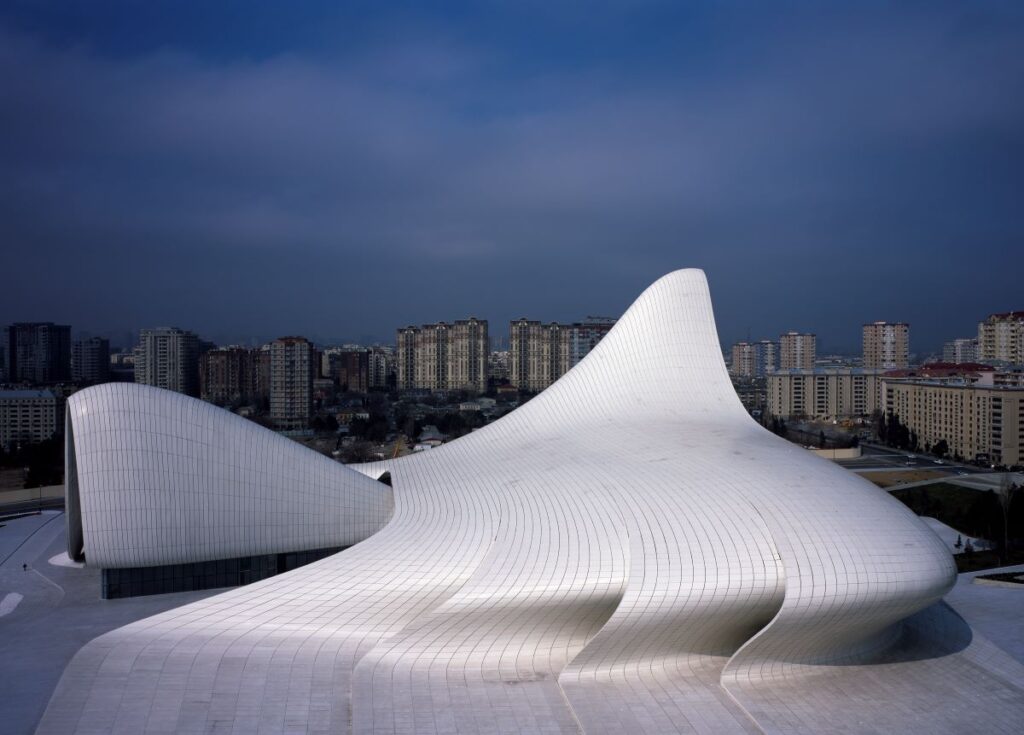
Photo Credit Zaha Hadid Architects | The photographers Hufton + Crow own the copyright to this photograph
Landscape as Architecture: Topographical Urbanism
The landscape strategy transforms a 20-meter topographic shear — once a site barrier — into a terraced civic promenade.

Photo Credit Zaha Hadid Architects | The photographers Hufton + Crow own the copyright to this photograph
The design introduces:
- Cascading water features
- Zigzagging pedestrian paths
- Subterranean parking (outside building footprint for security)
- Accessible roofscape that doubles as public plaza
The plaza panels — double-curved GFRC — transition seamlessly into the building envelope, reinforcing the continuity of surface. The landscape lighting (by HRN Dizayn) is embedded within steps, railings, and façade coves, creating a nocturnal glow that animates the fluid geometry.

Photo Credit Zaha Hadid Architects | The photographers Hufton + Crow own the copyright to this photograph
Environmental & Acoustic Performance
- Thermal Performance:
High-performance glazing and insulated rainscreen achieve passive thermal control.
Floor convectors and displacement ventilation mitigate glazing-induced drafts. - Acoustic Engineering (by Mezzo Stüdyo):
Baswa acoustic ceilings in auditorium.
Oak lamella wall cladding with integrated lighting gaps for sound diffusion.
Special acoustic ceilings with NRC ≥ 0.9 in performance spaces. - Lighting Design (by MBLD):
Daylight strategy: semi-reflective glass creates shifting reflections.
Nighttime strategy: interior lighting washes the external shell, revealing spatial depth without visual clutter.

Photo Credit Zaha Hadid Architects | The photographers Hufton + Crow own the copyright to this photograph
Project Animation
Project Gallery (Photo by Hufton + Crow)


Photography by Hufton + Crow
The photographers Hufton + Crow own the copyright of these images of Heydar Aliyev Center by Zaha Hadid Architects.
Please credit Hufton + Crow Photographers with any image used.
For publication, promotional, marketing or any other use, please contact Hufton + Crow for copyright permission.
Contact details:
Phone: +44 (0)203-4115316
Nick Hufton mob: +44 (0)7973-197645
Al Crow mob: +44 (0)7881-586726
E-mail: photos@huftonandcrow.com
Additionally, a credit must be printed with any publication, exhibition, or broadcast to Zaha Hadid Architects.
Project Gallery (Photo by Hélène Binet)


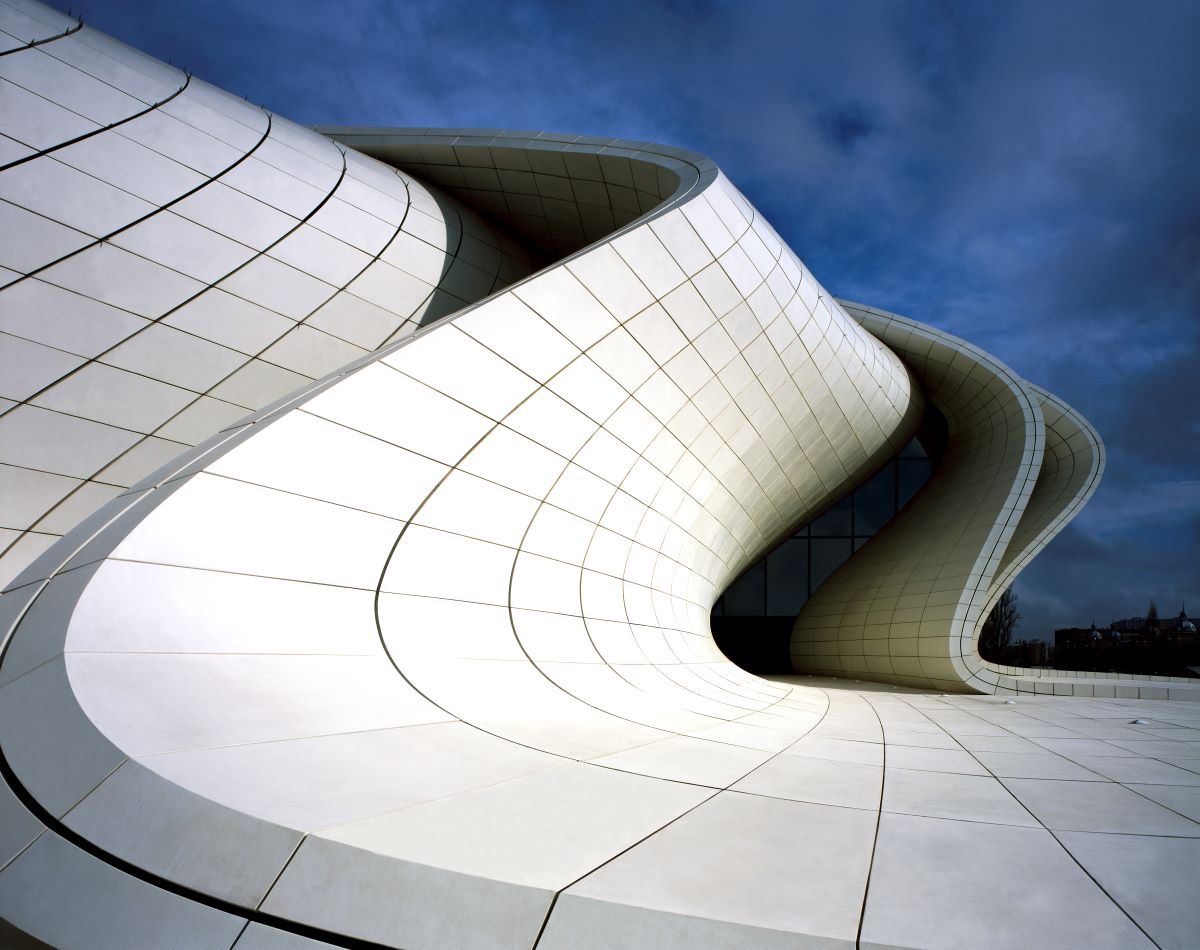


Photography by Hélène Binet
The photographer Hélène Binet owns the copyright of these photographs.
For all copyright permissions, please contact the photographer directly.
Photo credit must be printed with use ‘Photography by Hélène
Binet’.
Contact details:
Phone: +44 (0)20 7209 9596
E-mail: mail@helenebinet.com
Additionally, a credit must be printed with any publication, exhibition, or broadcast to Zaha Hadid Architects.
Project Gallery (Photo by Iwan Baan)


Photography by Iwan Baan
The photographer Iwan Baan owns the copyright of these images of Heydar Aliyev Center by Zaha Hadid Architects.
Please credit Iwan Baan with any image used.
For publication, promotional, marketing or any other use, please contact Iwan Baan for copyright permission.
Contact details:
Phone: +31 6 54 63 04 68
NYC Mob: +1 347 525 1554
HK Mob: +852 5149 6525
Fax: +31 84 883 1330
E-mail: studio@iwan.com
Additionally, a credit must be printed with any publication, exhibition, or broadcast to Zaha Hadid Architects.
Project Credits – Full Professional Roster
Architectural Design
- Design Architect: Zaha Hadid Architects
- Design: Zaha Hadid, Patrik Schumacher
- Project Architect: Saffet Kaya Bekiroglu
- Project Team: Sara Sheikh Akbari, Shiqi Li, Phil Soo Kim, Marc Boles, Yelda Gin, Liat Muller, Deniz Manisali, Lillie Liu, Jose Lemos, Simone Fuchs, Jose Ramon Tramoyeres, Yu Du, Tahmina Parvin, Erhan Patat, Fadi Mansour, Jaime Bartolome, Josef Glas, Michael Grau, Deepti Zachariah, Ceyhun Baskin, Daniel Widrig
Main Contractor & Architect of Record
- DiA Holding (UAE-Turkey JV)
- Project Coordinator: İpek Bulgurcu
- Project Manager: Cihan Erdoğanmez
- Construction Manager: Salih Oğuz Kadıoğlu
Consultants
Structure – Tuncel Engineering, AKT II
Façade – Werner Sobek
Mechanical – GMD Project
Electrical – HB Engineering
Acoustic – Mezzo Stüdyo
Fire – Etik Fire Consultancy
Geotechnical – Enar Engineering
Infrastructure – Sigal
Lighting – MBLD
Subcontractors & Manufacturers
Space Frame – MERO-TSK (DE) + Bilim Makina (TR)
External Cladding – Arabian Profile (UAE) — GFRP & GFRC
Internal Skin – Lindner (DE)
Auditorium Wood – Sanset İkoor (TR)
Auditorium Seating – Quinette (FR)
Lighting Fixtures – Zumtobel (AT)
Acoustic Ceilings – Baswa (CH) + Astas (TR)
Elevators – KONE (FI) + Ikma (TR)
Escalators – Thyssen Group (DE)
Fire Doors – Remak Makina (TR)
Landscape Lighting – HRN Dizayn (TR)
Flooring – Bolidt (NL)
Glass Doors – Solarlux (DE)
Marble Works – MM Mühendisler Mermer (TR)
Conclusion: A Built Manifesto for 21st-Century Architecture
The Heydar Aliyev Center is not a stylistic exercise. It is a built manifesto — a technological tour-de-force that fuses cultural narrative, computational design, and tectonic innovation. It redefines public space, national identity, and architectural possibility. For any architectural firm seeking to understand the future of fluid, performative, and culturally resonant architecture, this project is essential study material.
“We did not design a building. We designed a new ground — a civic interface where architecture becomes landscape, and landscape becomes culture.”
— Patrik Schumacher, Principal, Zaha Hadid Architects