
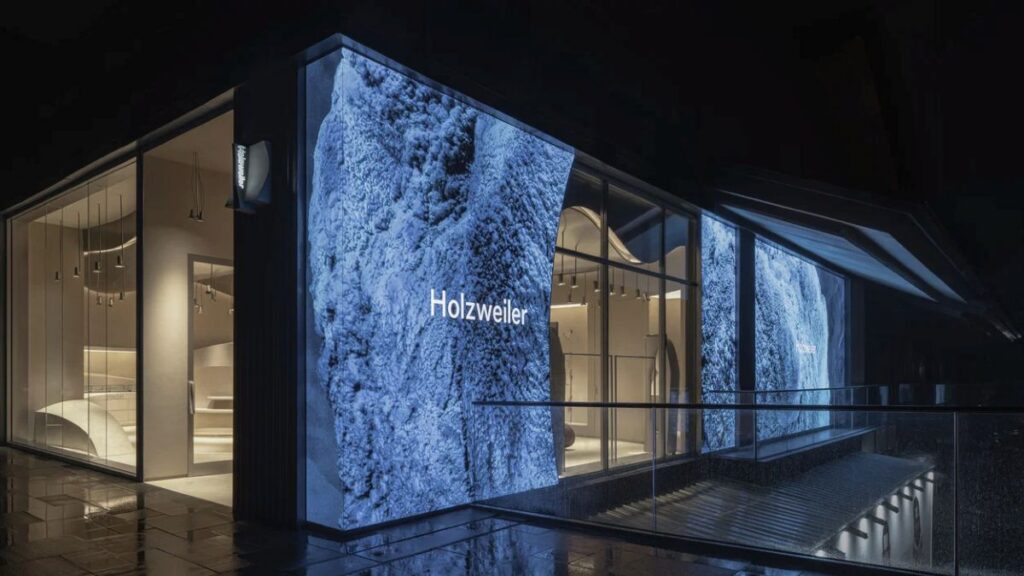
Holzweiler Chengdu Snøhetta retail store exterior LED façade Taikoo Li © Snøhetta
Curated by ArchiRev Editorial | Feature Story | Published May 29th, 2026 | Source: Snøhetta
Typologies: Retail, Interior Architecture
Themes: Architecture, Retail, Culture, Materiality, Experience
Status: Realised
Location: Chengdu, China
Year: 2022–2023
Surface: 130 m²
Client: Holzweiler
Snøhetta’s “Holzweiler Chengdu” is a retail interior space occupying 130 square metres in Taikoo Li, Chengdu, which is the first-ever outlet of the Norwegian fashion brand that is outside Scandinavia. This design, which was completed in 2023, expresses the brand identity of Holzweiler by creating an interior experience rooted in Norwegian landscape, coastline, and changing nature.
The shop revolves around the concept of “Elements of Norway,” where the forces of current, reflection, and contrast experienced within Nordic scenery are expressed through architectural expressions. The idea underlying this notion sees nature not as an image but rather as a system of spatial behavior.
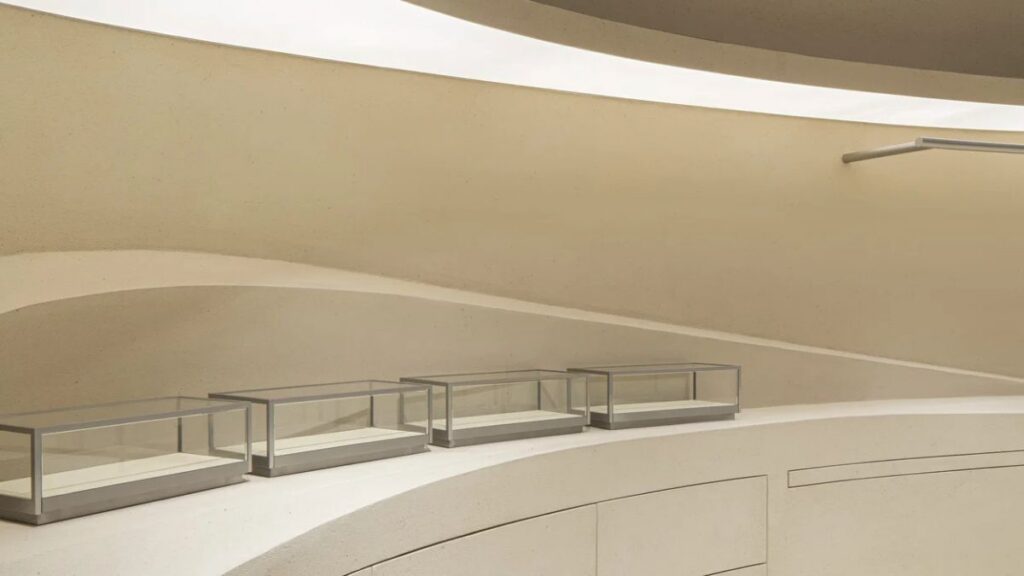
Holzweiler Chengdu Snøhetta interior warm clay tones fluid retail space © Snøhetta
Spatial experience requires constant movement. Organic shapes and soft transitions direct the visitor through the space, generating a series of spaces that vary in scale and strength. The façade of the shop is marked by cast glass, which provides an interesting relationship between the outside and the inside of the space.
Within the shop, a large-format LED screen creates the link between the city and Holzweiler’s brand world. It does not function merely as an ordinary surface of the display but rather as a dynamic window opening into the visual world of the fashion house.
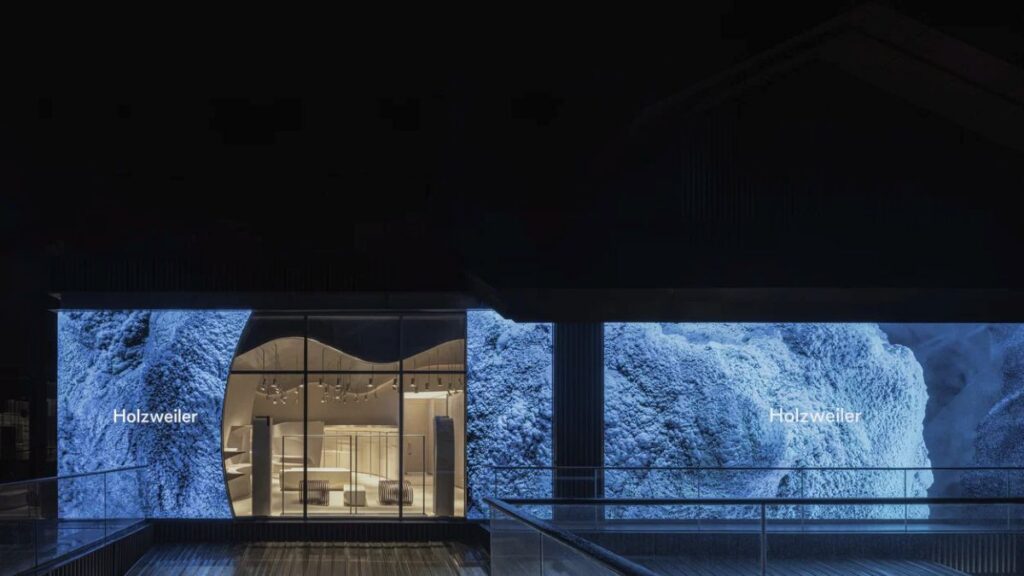
LED façade and cast glass entry framing interior visibility © Snøhetta
The interior palette has been carefully considered as well. Clay-colored tones have been used throughout, including rough textures and smooth finishes, providing an overall neutral setting that will be able to adapt easily to seasonal changes in the collection.
The ceiling makes one important atmospheric statement through the use of a wave-like steel surface, with a sandblasted finish that will reflect natural and artificial light. This surface creates an ever-changing depth effect and represents another way in which coastal motion is represented architecturally.
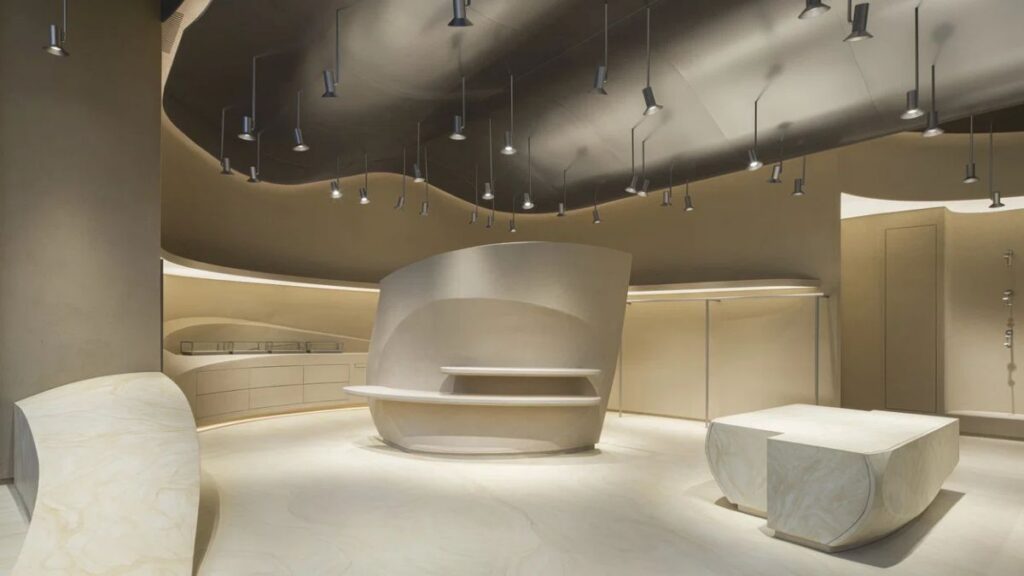
Wave-like ceiling reflecting interior movement and light conditions © Snøhetta
Transitions within the building are inspired by nature through their opposites, from rough to smooth, from opaque to reflective surfaces, and from static to dynamic. Flooring, made up of micro-cement with soft tonal gradation, provides the basis for the interior, and furniture features organic shapes evoking natural rocks and shoreline geometry.
The interior layout is highly flexible to allow seasonal rearrangements of the shop floor. Clothing rails, benches, and tables are designed as modular pieces, which help adjust the interior according to new clothing collections and themes.
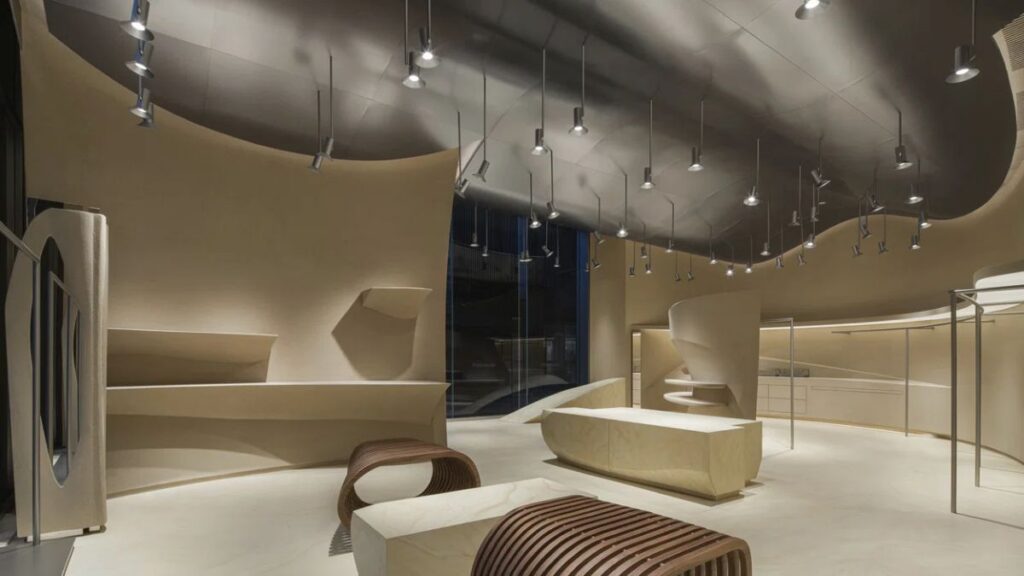
Display furniture and curved retail elements in central space © Snøhetta
As we move to the back of the store, the space gets much more intimate in nature. The product display spaces have been integrated within softer architectural volumes in which the transitions between the materials and lighting help achieve greater intimacy in the space.
Allusions to the Norwegian coast throughout the design are subliminal rather than literal, manifesting through form, transitions, and reflections. The end product is a space that functions not as a landscape depiction but as an atmospheric interpretation of it.
Completed in 2023, Holzweiler Chengdu provides an example of how retail interiors are not limited to being display spaces but can be used as experiential spatial systems where brand identity, material performance, and environmental allusion come together in one continuous architecture.