
The 73,000-square-metre performing arts centre fuses geological form, computational precision, and cultural symbolism to redefine Guangzhou’s waterfront identity.

© Zaha Hadid Architects | Photo by Iwan Baan
Curated by Archirev Editorial | Feature Story | Published Nov 4th 2025
Source: Zaha Hadid Architect
PROJECT TYPE: PERFORMING ARTS / CIVIC ARCHITECTURE
Project name: Guangzhou Opera House
Location: 1 Zhujiang Xi Road, Zhujiang New Town, Tianhe, Guangzhou, China
Architect: Zaha Hadid Architects
Design Lead: Patrik Schumacher
Project Directors: Woody K.T. Yao
Local Partner: Guangzhou Pearl River Foreign Investment Architectural Design Institute
Status: Built (Completed 2010)
Client: Guangzhou Municipal Government
Main Venues: 1,804-seat Opera Theatre + 443-seat Multi-function Hall
Construction Cost: 1.38 Billion RMB
Acoustics: Marshall Day Acoustics
Lighting: Beijing Light & View Co. Ltd.
Contractor: China State Construction Engineering Corp. Third Bureau Ltd
Size: 73,019 m² (40,558 m² above / 32,461 m² below ground)
Photography / Renders: © Zaha Hadid Architects / Hufton + Crow / Iwan Baan / Virgile Simon Bertrand
Overlooking the Pearl River in Guangzhou’s Zhujiang New Town, the Guangzhou Opera House by Zaha Hadid Architects (ZHA) stands as a defining symbol of China’s cultural evolution in the 21st century. Completed in 2010 for the Guangzhou Municipal Government, the 73,000 m² complex forms the centrepiece of Guangzhou’s waterfront redevelopment, reasserting the city’s position as a global cultural hub.
The project anchors the city’s expanding cultural district, linking Guangzhou’s urban grid to the river through a series of landscaped plazas and promenades. Its distinctive sculptural forms, fluid circulation, and advanced construction methods mark it as one of ZHA’s most significant built works in Asia, a synthesis of natural analogy, digital design, and performative architecture.
Design and Concept: A Landscape of Stone and Light
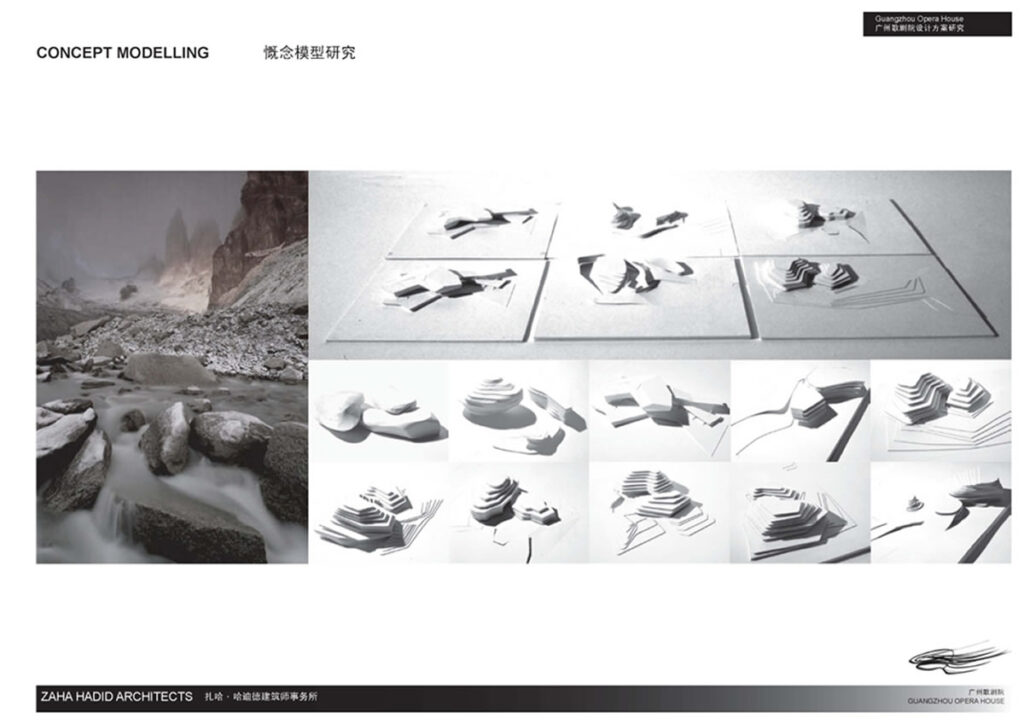
Conceived in 2002 following an international design competition, the opera house comprises two interlocking structures: a 1,804-seat grand theatre and a 443-seat multi-function hall. The larger volume houses the main auditorium, while the smaller accommodates rehearsal spaces, studios, and flexible event venues. Zaha Hadid herself described these two crystalline volumes as “twin boulders washed smooth by the flow of the river.”

Concept reference Image , Pebbles and Flow. © Zaha Hadid Architects | Concept Photography
Zaha Hadid’s sketches explore erosion and topography as generators of architectural form.
Each building appears as if carved from a continuous terrain, its geometry informed by erosion, flow, and natural topography. The design evokes the dynamic forces of the Pearl River that once shaped Guangzhou’s identity as a maritime city. “The idea of pebbles and rocks on the banks of a stream is significant for a project located next to the Pearl River,” Hadid reflected in 2011, describing the approach as “an analogy rather than a metaphor, expressing how the landscape itself becomes architecture.”
The architecture extends this analogy into the city fabric: ramps, terraces, and folds lift the surrounding ground plane into the structure, blurring the line between building and landscape. Visitors approach through gently sloping plazas that double as public gathering spaces and outdoor performance areas.
Physical Model of the Twin Volumes. © Zaha Hadid Architects | Model Photography
The project’s sculptural masses emerge organically from the landscape base.

Competition Model. © Zaha Hadid Architects | Concept sample models

Opera House resembles two pebbles washed out by water. © Zaha Hadid Architects | Photo by Iwan Baan
Structure and Materiality
The exterior is wrapped in a triangulated structural skin of glass, steel, and granite, each panel calibrated to the building’s irregular form. More than 75,000 granite cladding units and 24,700 square metres of façade stone were used across both volumes.

Tessellated Granite and Glass Skin. © Zaha Hadid Architects | Photo by Iwan Baan
Triangular panels translate fluid geometry into a crystalline architectural surface.
A charcoal-toned granite defines the main auditorium’s “boulder.” At the same time, a lighter grey finish covers the smaller multi-purpose hall, creating a visual dialogue of weight and luminosity. The tessellated façade emphasizes the crystalline nature of the geometry and reveals the precision of its digital fabrication. Beneath the surface, the structure relies on 59 uniquely cast steel joints weighing up to 36.6 tonnes, fabricated using medieval sand-casting techniques augmented by laser and GPS precision, hence ensuring structural rigidity within an otherwise asymmetrical shell.
The result is an expression of material and computational craft, bridging centuries-old techniques with contemporary parametric design.

Assembly of Steel Framework. © Zaha Hadid Architects | Photo by Marc Gerritsen
Each asymmetrical joint was custom-cast and positioned with millimetric precision.

Assembly of Steel Framework. © Zaha Hadid Architects | Photo by Marc Gerritsen
Interior: A Continual Fluid
Inside, the opera house continues its sculptural logic. The circulation sequence unfolds as a continuous topography of curved walls and interlocking staircases, guiding visitors through cavernous foyers toward the main auditorium.
The grand theatre is enveloped in champagne-gold glass-fibre-reinforced gypsum (GFRG) panels, folded and pleated into a seamless surface that integrates acoustic and lighting systems. The auditorium’s asymmetrical design enhances both spatial drama and acoustic performance, providing natural reverberation for Western operas while accommodating amplified sound for traditional Chinese performances.

Champagne-Gold Auditorium. © Zaha Hadid Architects | Photo by Virgile Simon Bertrand
Curved GFRG panels form a single pleated surface uniting acoustics and structure.
With the support of Marshall Day Acoustics, the design team calibrated every surface through digital modeling, ensuring a reverberation time of approximately 1.4 to 1.6 seconds. Subtle depressions in the GFRG panels reduce sound pressure near the stage, creating a balanced auditory environment. Overhead, a constellation of 4,000 LED lights scatters across the ceiling, evoking a luminous silk canopy.
Hadid described the space as “an ultimate fluid environment, one single surface with many pleats and folds that integrate acoustics, structure, and lighting into a coherent whole.”

Interior Circulation and Foyer Landscape. © Zaha Hadid Architects | Photo by Hufton + Crow
Sweeping staircases and sinuous walls guide visitors from the plaza to the auditorium.
Beyond its two main performance halls, the complex includes rehearsal rooms for ballet, opera, and orchestra, 43 dressing rooms, and a suite of technical spaces for stage machinery and lighting systems. The venue’s four basement levels provide parking for 322 cars, as well as coach and VIP facilities.
Architecture tours are open to the public, offering insight into the building’s design and construction between Tuesday and Sunday, 10:00 a.m.–4:30 p.m.

GOH Interior. © Zaha Hadid Architects | Photo by Virgile Simon Bertrand
Technology and Precision
The Guangzhou Opera House is among ZHA’s earliest experiments in parametric modeling and 3D digital fabrication on a monumental scale. The contractors developed bespoke wax molds for the GFRG panels, which were fabricated directly from ZHA’s 3D computer files. This digital-to-physical workflow allowed for millimetric accuracy in the realization of complex geometries.
Beyond its aesthetic impact, the design demonstrates a significant technological leap in how computational tools enable expressive yet precise architecture. The opera house’s asymmetrical frame, spanning up to 70 metres, was modeled, tested, and fabricated with unprecedented accuracy for its time.

Parametric Framework Simulation. © Zaha Hadid Architects | Visualization Team
Advanced modeling enabled the coordination of complex geometry and construction logic.
Urban and Cultural Context
Located at the convergence of Zhujiang Boulevard and the Pearl River Promenade, the Guangzhou Opera House occupies a strategic site within the city’s master plan for civic and cultural development. It forms part of a constellation of institutions including the Guangdong Museum and the Guangzhou Library, that collectively define Zhujiang New Town as the city’s cultural core.
The building’s landscaped forecourt serves as both an urban threshold and a public amphitheatre, connecting Guangzhou’s central business district to the waterfront. Beneath its sculpted surface, four underground levels accommodate parking, backstage facilities, and rehearsal studios, optimizing the compact urban footprint.

Civic Plaza and Riverfront Connection. © Zaha Hadid Architects | Visualization Team
The design opens Guangzhou’s city centre to the river, featuring terraced public spaces..
Construction and Timeline
The project began following a 2002 international competition, with schematic design commencing in 2004 and ground-breaking in 2005. Construction was managed by the Guangzhou Municipal Construction Group Co., Ltd., with the China State Construction Engineering Corporation Third Bureau Ltd. serving as the main contractor. The structure topped out in 2009, followed by acoustic testing and an inaugural performance in 2010.

Shell Assembly Nearing Completion. © Zaha Hadid Architects | Photo by Christian Richters
The complex geometry of the twin structures under construction before façade installation.
Legacy and Reflection
More than a performance venue, the Guangzhou Opera House has become a symbol of China’s architectural confidence and a landmark of global contemporary design.
“The design reflects China’s rich cultural history, but also the remarkable future China will play on the world stage.” — Zaha Hadid

Guangzhou Opera House Illuminated at Dusk. © Zaha Hadid Architects | Photo by Hufton + Crow
The twin forms glow against the skyline, bridging tradition and modernity.
Archirev Insight
The Guangzhou Opera House redefined architectural expression in the early digital age. It remains a pivotal work that translated computation, craft, and cultural narrative into built form — a lasting dialogue between nature and technology.
Project Gallery (Photo by Iwan Baan)


Photography by Iwan Baan.
The photographer Iwan Baan owns the copyright of these photographs. Please contact the photographer directly for permission to publish.
Contact Details:
Phone: +31 6 54 63 04 68 NYC
Mob: +1 347 525 1554 HK
Mob: +852 5149 6525
Fax: +31 84 883 1330
Email: studio@iwan.com
Additionally, a credit must be printed with any publication, exhibition, or broadcast to Zaha Hadid Architects.
Project Gallery (Photo by Virgile Simon Bertrand)


Photography by Virgile Simon Bertrand.
The photographer Virgile Simon Bertrand owns the copyright of these photographs. Please contact the photographer for copyright conditions.
Photo credit ‘Photography by Virgile Simon Bertrand’ must be printed with use.
Contact details: Phone: (+852) 2526 4465, Mob: (+852) 9605 7781, Email: mail@virgilebertrand.com
Additionally, a credit must be printed with any publication, exhibition, or broadcast to Zaha Hadid Architects.
Project Gallery (Photo by Hufton+Crow)


Photography by Hufton+Crow.
The photographers Hufton+Crow own the copyright of these photographs.
Photo credit ‘Hufton+Crow Photographers’ must be printed
with use.
Editorial use only, Promotional and Marketing use prohibited.
For any other usage, including commercial, the photographer
must be contacted.
Contact details:
Phone: +44 (0)203-4115316
Nick Hufton mob: +44 (0)7973-197645
Al Crow mob: +44 (0)7881-586726
E-mail: photos@huftonandcrow.com
Additionally, a credit must be printed with any publication, exhibition, or broadcast to Zaha Hadid Architects.
More Project Gallery (Photo by Christian Richters)


Photography by Christian Richters.
The Photography Christian Richters owns the copyright of these photographs. Please contact the photographer for copyright conditions.
Please contact the photographer directly for permission to
publish the photographs.
Contact details:
Phone: +49 251 277447
Mob: +49 172 530 1920
E-mail: chrichters@aol.com
Project Credits
The Guangzhou Opera House stands as a landmark of international collaboration, integrating world-class architectural vision with local engineering and construction expertise.
Architectural Design
Zaha Hadid Architects, London, UK
(Design: Zaha Hadid; Project Directors: Woody K.T. Yao, Patrik Schumacher; Project Leader: Simon Yu)
Local Design Institute
Guangzhou Pearl River Foreign Investment Architectural Designing Institute, Guangzhou, China
Project Delivery
Project Management: Guangzhou Municipal Construction Group Co., Ltd., Guangzhou, China
Site Supervision: Guangzhou Construction Engineering Supervision Co., Ltd., Guangzhou, China
Principal Contractor: China State Construction Engineering Corporation Third Bureau Ltd., Wuhan, China
Engineering & Specialist Design
Structural Engineering: SHTK; Guangzhou Pearl River Foreign Investment Architectural Designing Institute
Façade Engineering: KGE Engineering, Zhuhai, China
Building Services: Guangzhou Pearl River Foreign Investment Architectural Designing Institute
Acoustics: Marshall Day Acoustics, Melbourne, Australia
Theatre Consultancy: ENFI Engineering Corporation, Beijing, China
Lighting Design: Beijing Light & View Co., Ltd., Beijing, China
Cost Consultancy: Guangzhou Jiancheng Engineering Costing Consultant Office Ltd., Guangzhou, China
Key Subcontractors
Building Works: Guangdong Haohe Construction Co., Ltd., Guangzhou, China
M&E Works: Guangdong Industrial Equipment Installation Company, Guangzhou, China
Drainage: Geberit Shanghai Investment Administration Co. Ltd., Shanghai, China
Intelligent Systems: Guangdong Jian’an Intelligent Systems Limited, Guangzhou, China
Stage Systems
Opera House Stage Machinery: Waagner Biro; Engineering Design and Research Institute of General Equipment Headquarters
(Vienna, Austria / Beijing, China)
Multifunction Hall Stage Machinery: SBS Bühentechnik GmbH, Dresden, Germany
Stage Lighting: Hangzhou Yidashi Lighting Equipment Co., Ltd., Hangzhou, China
Interiors & Finishes
Interiors: Shenzhen Zhongfutai Industry Co., Ltd.; Guangdong Decoration Co., Ltd.
GRG Works: E-Grow International Trading Shanghai Co., Ltd.; Shanghai YingChuang Design Engineering Co., Ltd.
Surface Materials – LG Hi-Macs: Guangzhou Kangxun Trading Co., Ltd., Guangzhou, China
Flooring: Freudenberg Group (nora), Shanghai, China
Auditorium Seating: Zhejiang Shenge Industrial Co., Ltd., Ningbo, China
Seating Fabric: Kvadrat, Ebeltoft, Denmark
Design Support
Early design development was strengthened by notable contributions from Filippo Innocenti, Matias Musacchio, and Jenny Huang.