
Fluid Geometry, Cultural Legacy, and a New Civic Heart for Guangzhou’s Southern Gateway

Greater Bay Area Sports Centre. © Zaha Hadid Architects / Atchain
Curated by Archirev Editorial | Feature Story | ≈ 1,500 words | Published Nov 3rd 2025
Project texts and description provided by Zaha Hadid Architect
Project type: Sports and Civic architecture
Project name: Greater Bay Area Sports Centre
Location: Nansha, Guangzhou, China
Architect: Zaha Hadid Architects
Design Lead: Patrik Schumacher
Project Directors: Lei Zheng, Nils Fischer
Executive Architect: Guangdong Architectural Design & Research Institute (GDAD), CSWADI
Construction Start Date: August 31, 2023
Completion Date: (Completion Scheduled June 2025)
Status: Substantial Completion
Client: Cultural, Radio, Television, Tourism & Sports Bureau of Nansha District
Facilities: 60,000-seat stadium, 20,000-seat arena, 4,000-seat aquatics centre, athlete village & training fields
Size: 700,000 m² over a 70-hectare site
Photography / Renders: © Hufton + Crow / Zaha Hadid Architects / Atchain / Frontop / Proloog/Plomp
A New Symbol for the Greater Bay
The Greater Bay Area Sports Centre, designed by Zaha Hadid Architects (ZHA), stands as a defining landmark poised to transform Nansha, China, into a global hub of architecture, culture, and sports. Positioned at the southern end of Guangzhou’s Nansha District along the Pearl River, the development anchors the emerging civic, business, and residential core of the Guangdong–Hong Kong–Macau Greater Bay Area—a megaregion projected to accommodate 100 million residents by 2030. Currently in its final phase of interior finishing and landscaping, the centre was initially scheduled for completion in June 2025 and will host the China National Games in November 2025

Integrated Urban and Parkland Design
The 70-hectare park combines civic, sports, and ecological functions within a unified landscape.
© Zaha Hadid Architects | Render by Frontop

Integrated Urban and Parkland Design – Construction Image
© Zaha Hadid Architects | CRLand
A City Within a Park
Measuring 700,000m² within a lush 70-hectare park, this architectural gem seamlessly integrates a 60,000-seat stadium, a 20,000-seat arena for basketball and indoor events, and a 4,000-seat aquatics centre featuring a 50-metre swimming pool and diving well. Designed to serve Nansha’s local schools and sports clubs, it also advances China’s regional and national sports development initiatives, offering state-of-the-art infrastructure for athletes competing in all track and field disciplines. The design capitalizes on Nansha’s warm winters to create ideal outdoor training environments, laying the foundation for enduring athletic legacies.

The Stadium and Arena from Above
Three main venues interwoven with gardens, promenades, and water channels.
© Zaha Hadid Architects / Negativ
Concept & Symbolism
Drawing inspiration from the region’s rich heritage, the centre’s fluid forms mirror the tapering geometries of traditional Song Dynasty sailing ship hulls, which historically positioned the Pearl River as China’s premier global trade route over a thousand years ago. This design philosophy extends to the integration of Lingnan vernacular architecture, incorporating shaded, naturally ventilated spaces to mitigate the humid subtropical summers.

Stadium Inspired by the hulls of traditional sailing ships © Zaha Hadid Architects / Atchain
The 60,000-seat stadium, 20,000-seat arena, and 4,000-seat aquatics centre are unified by curvilinear roofs and louvred façades that echo the elegance of pleated silk Chinese fans. This innovative layered roof shields spectators from rain and sunlight while naturally expelling warm air, exemplifying sustainable design. Their flowing silhouettes evoke the motion of sails, thereby serving as a tribute to the region’s maritime culture and to Nansha’s emergence as a gateway of trade and exchange.

Fluid Geometry — Stadium
Layered roof forms resemble pleated silk fans, a modern interpretation of the Lingnan vernacular aesthetic.
© Zaha Hadid Architects / Proloog
Climate and Façade
The buildings’ curvilinear forms, defined by a network of vertical louvres, were optimized through advanced 3D modeling to promote shading and natural cooling by harnessing the prevailing summer winds from the South China Sea.
The stadium’s grand arch facilitates airflow and offers breathtaking views from the river, forging a profound connection between spectators and the riverside setting during sports and cultural events. The adjustable seating bowl ensures optimal viewing angles and atmospheres for a diverse range of occasions, from athletic competitions to performances with a striking stage backdrop.

The Stadium’s Southern Archway
A defining feature that connects spectators to the Pearl River through air and light.
© Zaha Hadid Architects | Render by Plomp
Environmental Integration
Strategically positioned near the Shenzhen–Zhongshan Bridge and accessible via Line 18 of the Guangzhou Metro, the complex serves as a gateway between the urban centres of the Greater Bay Area. This connectivity transforms the project into both a local gathering space and an international venue for cultural exchange.
The surrounding 70-hectare parkland integrates wetlands and green corridors that serve dual purposes: recreation and flood resilience.
The landscape design manages stormwater during extreme sea-level fluctuations, positioning the sports centre as a vital component of Nansha’s climate adaptation strategy.

Wetland Integration Along the Pearl River
Native planting and water retention systems provide natural cooling and flood control.
© Zaha Hadid Architects | Render by Frontop
Construction & Collaboration
Commissioned by the Nansha District Bureau of Culture & Sports following a 2023 international design competition, this project reflects ZHA’s collaboration with the Guangdong Architectural Design & Research Institute.
Roofing and curtain wall installations were completed in February 2025 by the construction consortium led by China Construction Eighth and Third Engineering Divisions, under the architectural supervision of Zaha Hadid Architects and the Guangdong Architectural Design & Research Institute.

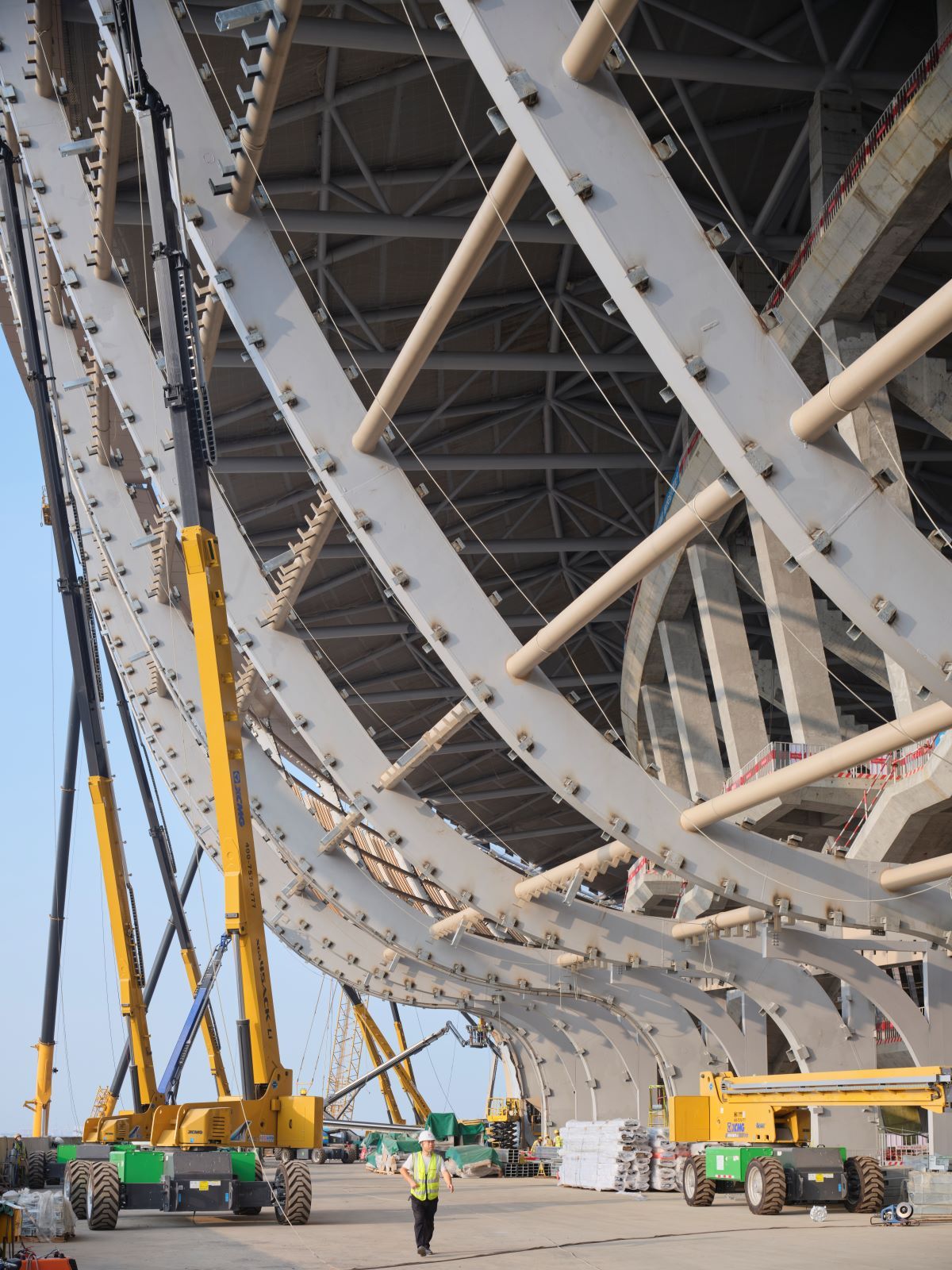
Roof Truss Assembly in Progress – October 2024
Steel components lifted into position over the stadium bowl.
© Zaha Hadid Architects | Xue Liang


Nearing Completion — March 2025
Aerial view of completed roofs and façades before final landscaping.
© Zaha Hadid Architects | CRLand
A New Civic Identity
The Greater Bay Area Sports Centre exemplifies Zaha Hadid Architects’ philosophy of “architecture as performance,” where form and environment converge to create living public spaces. Blending innovation, culture, and ecological awareness, the project defines a new model for civic development in China’s southern metropolis.

A New Civic Icon at Dusk
Illuminated rooflines reflect across the Pearl River, symbolizing the unity of the Greater Bay cities.
© Zaha Hadid Architects | Render by Prolong
Construction Video
From Vision to Reality — Building the Greater Bay Area Sports Centre
A time-lapse video of construction progress from 2023 to 2025.
Project Gallery



Photography by Xue Liang.
The photographer Xue Liang owns the copyright of these photographs and gives license to use without fees. Photo credit ‘©Xue Liang’ must be printed with use. Editorial use only, Promotional and Marketing use prohibited. For any other usage, including Commercial, the photographer must be contacted at: Phone: +8618662210213, E-mail: xueliangzhenman@163.com.
Additionally, a credit must be printed with any publication, exhibition, or broadcast to Zaha Hadid Architects.
More Project Gallery (Photo by CRLand)


Project Credits
- Architect: Zaha Hadid Architects (ZHA)
- Design: Patrik Schumacher
- ZHA Project Directors: Lei Zheng, Nils Fischer
- ZHA Project Associates: Jinqi Huang, Vishu Bhooshan, Jakub Klaska
- ZHA Project Architect: Hung-da Chien
- ZHA Project Team: Teodor Andonov, Shajay Bhooshan, Taizhong Chen, Heba Eiz, Vegard Elseth, Matthew Gabe, Sonia Magdziarz, Ling Mao, Keerti Manney, Xin Swift, Ke Yang, Chris Whiteside, Svenja Siever, Tul Srisompun
- ZHA Competition Team: Luca Bacilieri, Niran Buyukkoz, Junfei Chen, Nils Fischer, Matthew Gabe, Jakub Klaska, Han Hsun Hsieh, Jingwen Yang, Paul Joseph, Shuaiwei Li, Juan Liu, Sonia Magdziarz, Yuling Ma, Satoshi Ohashi, Michael On, Xin Swift, Ceren Tekin, Ke Yang, Bo Zhang, Chu Zhou, Lei Zheng
- Competition Sports Consultant: Clive John Lewis
- Competition Consortium Member: Guangzhou Architectural Design & Research Institute
- Consultants:
- Executive Architect: Guangdong Architectural Design & Research Institute Group (GDAD), China Southwest Architectural Design and Research Institute (CSWADI)
- Structural Engineers: GDAD, CSWADI
- General Contractor: China Construction Eighth Engineering Division & China Construction Third Engineering Division
- Façade Engineering: RFR (Rice Francis Ritchie sarl) Engineers, GDAD, CSWADI
- M&E Engineering: GDAD, CSWADI
- Landscape Consultant: AECOM
- Lighting Design: Lichtvision Design & Tsinghua Urban Planning and Design Institute (THUPDI)
- Site Supervision: Guangzhou Runhe Consulting, Guangzhou Pearl River Supervision and Consulting Group, Guangzhou Construction Engineering Supervision Co.